Die springs are core elastic components for stamping, injection molding, die casting, thermoforming and other types of molds. Rectangular cross-section compression springs serve as the standard mainstream type, undertaking critical functions including stripper reset, ejection demolding, slide core pulling, parting surface preloading, shock absorption and buffering. Most mold failures, production downtime and poor part accuracy stem from improper spring material selection and mismatched load grades. This article comprehensively analyzes five core dimensions: basic spring grading, performance of mainstream materials, cross-industry application scenarios, working condition matching principles and common failure avoidance, providing full-process references for design, procurement and mold maintenance.
I. Load Grades of Standard Die Springs (Color Coding Guide)
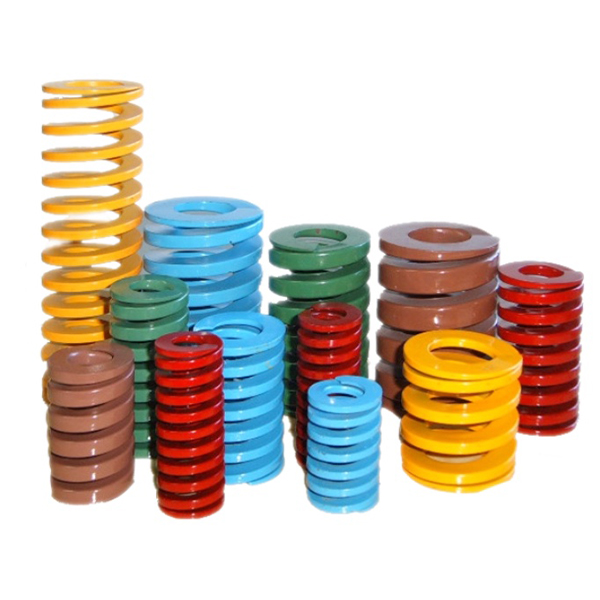
Rectangular die springs complying with the universal Japanese JIS standard adopt color codes to distinguish load capacities. Compression rate directly determines service life; load matching is the first step of selection:
|
Color Code |
Load Grade |
Max Allowable Compression |
Core Application Scenarios |
| Yellow DF |
Light Load |
58% |
Micro precision molds, thin sheet ejection, low-frequency small tooling |
| Blue DL |
Medium-Light Load |
48% |
Small injection molds, simple thin-sheet stamping, general positioning mechanisms |
| Red SM |
Medium Load |
38% |
General plastic molds, conventional sheet metal stamping, most widely used across industries |
| Green SH |
Heavy Load |
28% |
Thick plate stamping, high-speed progressive dies, medium & small die casting slides |
| Brown SB |
Extra Heavy Load |
24% |
Automotive body panels, large multi-station dies, heavy-duty die casting core pulling |
Auxiliary elastic components: standard round compression springs, disc springs, nitrogen gas springs and polyurethane springs, mainly used for composite elastic structures, confined spaces and constant-force long-stroke applications.
II. In-depth Analysis of Mainstream Die Spring Materials (Performance, Temperature Resistance, Pros & Cons, Application Scenarios)
Material governs four core properties of springs: high temperature resistance, fatigue resistance, stress relaxation resistance and corrosion resistance. Materials fall into three categories: general alloy spring steel, corrosion-resistant stainless steel and ultra-high-temperature special alloys.
(I) General Alloy Spring Steel (First Choice for 90% Mass Production Molds)
1.65Mn Manganese Steel
▫️Hardness: HRC44~48, long-term operating temperature ≤80℃
▫️Advantages: Low cost, easy procurement, basic elasticity meets low-frequency operation
▫️Disadvantages: Poor heat resistance, prone to stress relaxation under high temperature, short fatigue life, easy fracture under high-frequency reciprocation
▫️Suitable for: Simple temporary tooling, low-frequency small-batch molds, non-mass-production equipment with limited budgets
▫️Forbidden for: High-speed progressive dies, die casting molds, molds for continuous long-term mass production
2.60Si2MnA Silicon-Manganese Steel
▫️Hardness: HRC45~49, long-term operating temperature ≤200℃
▫️Advantages: High elastic limit, good hardenability, moderate cost performance
▫️Disadvantages: Average impact toughness, prone to fatigue cracks under heavy-load high-frequency conditions
▫️Suitable for: Medium-light load stamping at ambient temperature, standard small & medium injection molds
3.50CrVA Chromium-Vanadium Steel (Universal Mainstream Material for All Industries)
▫️Hardness: HRC46~50, long-term operating temperature ≤250℃
▫️Advantages: Vanadium refines grain structure, delivering strong toughness, impact resistance, fatigue resistance and permanent deformation resistance. Shot peening treatment extends service life by over 40%.
▫️Disadvantages: Higher price than silicon-manganese and manganese steel
▫️Suitable for: Most stamping & injection molds, high-speed terminal progressive dies, standard auxiliary parts for aluminum alloy die casting
4.55CrSi Chromium-Silicon Steel (Specially for High-Temperature Die Casting)
▫️Hardness: HRC47~52, long-term operating temperature ≤300℃
▫️Advantages: High-silicon formula delivers excellent heat resistance with minimal elastic attenuation at high temperatures; far superior thermal relaxation resistance compared to 50CrVA
▫️Disadvantages: Slightly lower impact toughness than chromium-vanadium steel
▫️Suitable for: Zinc/Aluminum/Magnesium alloy die casting molds, hot compression forming molds, long-term high-temperature environments above 150℃
(II) Corrosion-Resistant Stainless Steel Series (Humid, Clean, Rust-Free Environments)
1.304 Austenitic Stainless Steel
▫️Operating temperature: -40℃ ~ 180℃, non-magnetic, fully rust-proof
▫️Disadvantages: Lower elastic modulus than alloy steel; larger installation space required for equal spring force
▫️Suitable for: Water-cooled molds, food & medical molds, semiconductor micro molds, environments with acidic & alkaline release agents
2.17-7PH (631) Precipitation Hardening Stainless Steel
▫️Operating temperature ≤280℃, balances high strength and corrosion resistance
▫️Suitable for: Precision micro heavy-load molds, chip packaging molds, high-cleanliness molds for new energy components
(III) Ultra-High-Temperature Special Alloys (Extreme Environments Above 300℃)
▫️3J1 Iron-Nickel-Chromium Elastic Alloy: Stable long-term performance at 350℃, resistant to damp heat oxidation; for composite hot compression molds and metal hot forging tooling
▫️Inconel X-750 Nickel-Based Superalloy: Anti-oxidation up to 550℃ long-term operation, withstands molten metal splashing; customized for aerospace titanium alloy hot forming and special high-temperature die casting molds
Quick Reference Comparison of Core Material Properties
|
Material |
Max Operating Temp |
Fatigue Resistance |
Thermal Relaxation Resistance |
Rust Resistance |
Overall Cost |
| 65Mn |
≤80℃ |
Poor |
Extremely Poor |
Poor |
Lowest |
| 60Si2MnA |
≤200℃ |
Fair |
Fair |
Poor |
Low |
| 50CrVA |
≤250℃ |
Excellent |
Good |
Poor |
Medium |
| 55CrSi |
≤300℃ |
Good |
Excellent |
Poor |
Medium-High |
| 304 Stainless Steel |
≤180℃ |
Fair |
Fair |
Excellent |
High |
| 17-7PH |
≤280℃ |
Excellent |
Good |
Excellent |
Very High |
| Inconel X-750 |
≤550℃ |
Outstanding |
Outstanding |
Excellent |
Extremely High |
III. Detailed Cross-Industry Applications of Die Springs
(I) Metal Stamping Molds (Largest Application Segment)
Application Positions
Stripper plates, lifter pins, pressure plates, bending ejectors, piercing ejection, slide reset, ejection for multi-station progressive dies, drawing buffering for automotive body panels
Selection for Subdivided Scenarios
▫️Thin-sheet household appliance blanking molds: Medium frequency at ambient temperature; adopt red medium-load 50CrVA springs with compression controlled at 30%~38%
▫️High-speed terminal connector progressive dies: Hundreds of reciprocating impacts per minute; select shot-peened green/brown 50CrVA springs with compression ≤28%
▫️Stamping of thick structural components for construction machinery: Instant heavy impact; extra-heavy-load brown springs combined with nitrogen gas springs
▫️Automotive door drawing & forming molds: Stable force and long stroke; composite elastic system of red + green springs
(II) Plastic Injection Molds (3C, Home Appliance, Automotive Interior Parts)
Application Positions
Ejector plate reset, angle lifter/slide core pulling, sprue ejection, parting surface preloading, hot runner buffering
Working Condition Features
Long-term operation at 60~120℃, oily release agents, stable load without severe impact
Matching Selection
▫️Micro electronic connector molds: Yellow/blue light-load 50CrVA
▫️Automotive interior & large household appliance housings: Red medium-load 50CrVA
▫️High-temperature hot runner molds (100~150℃): High-temperature tempered 50CrVA; 65Mn is prohibited
(III) Aluminum/Zinc Alloy Die Casting Molds (Core High-Temperature Heavy-Load Scenarios)
Application Positions
Core pulling slides, ejection mechanisms, gate buffering, parting surface preloading
Extreme Working Conditions
Sustained high temperature of 150~300℃, thermal radiation from molten metal, corrosion by release agents, strong impact during mold opening & closing
Mandatory Selection Standard
Uniformly adopt 55CrSi chromium-silicon steel; heavy-load slides matched with green/brown load grades, guide sleeves installed to prevent lateral bending and fracture
(IV) Special Hot Compression / Hot Forging Molds
Continuous high temperature of 200~350℃ leads to rapid failure of ordinary alloy steel. 3J1 alloy is used for composite hot compression molds; customized Inconel X-750 superalloy springs for aerospace titanium hot forming.
(V) Precision Micro Molds (Semiconductor, Medical, Consumer Electronics)
Micro packaging and medical micro-component molds feature compact spaces and humid environments. Prioritize 304/17-7PH stainless steel springs to eliminate rust debris contamination of precision workpieces.
(VI) Extended Downstream Industry Applications
1.New Energy Industry: Drawing molds for power battery shells, energy storage structural parts, motor core progressive dies; shot-peened 50CrVA springs standard for high-frequency operation
2.Automotive Manufacturing: Body stamping, interior injection molding, integrated die casting, welding tooling; 55CrSi material mandatory for all heavy-load die casting
3.3C Electronics: High-speed progressive dies for mobile phone middle frames, connector terminals and plastic housings
4.Medical & Food Industries: Stainless steel springs resistant to acid & alkali cleaning, free of heavy metal contamination
5.Automated Tooling & Fixtures: Positioning clamping, buffering ejection, quick jig reset; replace ordinary round springs to boost clamping stability
6.Aerospace: Custom superalloy springs for special high-temperature hot forming molds
IV. Standardized Selection Logic (One-Stop Matching of Materials & Specifications)
Step 1: Confirm Mold Operating Temperature
▫️Mass production at ambient temperature <80℃: General 50CrVA
▫️Conventional injection molding at 80~180℃: High-temperature tempered 50CrVA
▫️Die casting / hot compression at 180~300℃: 55CrSi chromium-silicon steel
▫️Special hot forming above 300℃: 3J1 / Inconel superalloys
▫️Humid, acid-alkaline, clean production environments: 304 / 17-7PH stainless steel
Step 2: Determine Load and Operating Frequency
▫️Low frequency & light load: Yellow/blue load grades, 60Si2MnA / 50CrVA
▫️Continuous mass production & high-frequency reciprocation: Red/green load grades, shot-peened 50CrVA
▫️Thick plates, large die casting, high impact force: Green/brown load grades, 50CrVA / 55CrSi
Step 3: Control Safe Compression Rate
Strictly follow the maximum compression rate corresponding to each color. For long-term service, keep actual compression within 70% of the rated limit to avoid permanent deformation and fracture.
V. Common Failure Modes & Pitfalls of Improper Material Selection
1.Spring softening and force attenuation in short service life
50CrVA incorrectly applied to high-temperature die casting environments without heat-resistant 55CrSi; high-temperature creep causes permanent elastic loss.
2.Frequent fracture and fatigue crack generation
Low-cost 65Mn adopted for high-speed progressive dies with insufficient fatigue resistance; no shot peening treatment; compression rate exceeding safety limits.
3.Spring rusting and workpiece scratches by iron debris
Ordinary alloy steel used for water-cooled, food and medical molds without stainless steel matching.
4.Spring shortening after long service and insufficient ejection stroke
Poor stress relaxation resistance of material, or omission of presetting stress relief process; excessive compression rate.
VI. Conclusion
The service life, operational stability and product yield of molds are jointly determined by three factors: material, load grade and working condition matching.
50CrVA chromium-vanadium steel is the universal all-purpose material for all industries, covering most ambient-temperature stamping and injection molding applications. 55CrSi chromium-silicon steel targets high-temperature die casting scenarios. Stainless steel grades address corrosion and high-cleanliness precision production requirements. Ultra-high-temperature special alloys suit extreme environments such as aerospace and hot forming.
During mold design and procurement, prioritize operating temperature, load frequency and production environment as core selection criteria. Combined with strengthening processes including shot peening, presetting stress relief and high-temperature tempering, maintenance downtime costs can be greatly reduced and the overall service life of molds extended.

 Tiktok

 Kwai

 REDnote


