1. Overview
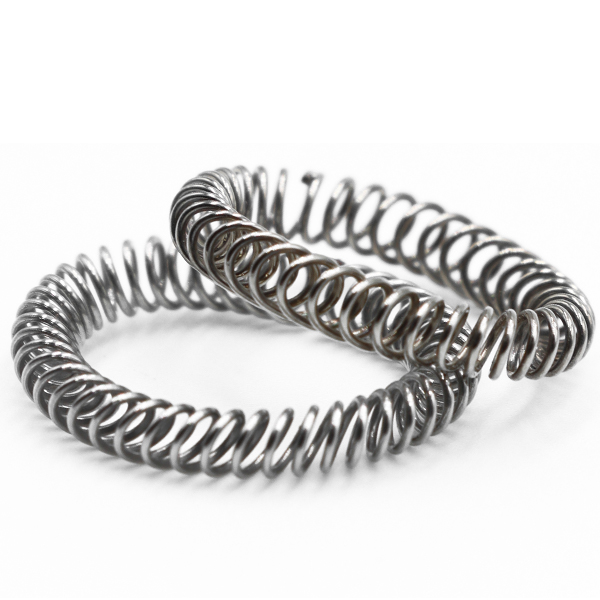
With an inclined coil structure, canted coil springs deliver continuous radial elastic compensation, widely applied in spring energized sealing, conductive contact fingers and mechanical locking assemblies. A service life requirement of ≥10,000 cycles is frequently raised by customers. This cycle count represents a basic durability threshold that can be easily achieved by most elastic alloys.
However, if the working conditions involve high-frequency reciprocation, high temperature, corrosion or sustained micro-movement friction, high-fatigue base materials must be selected accordingly to guarantee stable elastic force without fracture or coating peeling.
This document categorizes mainstream materials by application scenarios, specifying fatigue performance, applicable working conditions, advantages and disadvantages to facilitate material selection and technical documentation compilation.
2. Detailed Introduction to Four Categories of Applicable Materials
2.1 General Economical Grade: 316 Stainless Steel
◦Fatigue Life Performance
•Under standard rational compression (15%~30%), it can steadily withstand more than 100,000 cycles. No elastic force attenuation or fracture risk occurs after 10,000 cycles, fully meeting basic service life requirements.
◦Core Advantages
•Low material cost with inherent rust resistance; no complex coating required for ordinary oil, clean water and weak acid environments. Stable wire forming performance, suitable for mass production of sealing canted coil springs.
◦Disadvantages
•Low elastic limit. Long-term over-compression will cause obvious elastic force decline after tens of thousands of cycles. Poor electrical conductivity, not applicable for conductive components.
◦Applicable Scenarios
•Energizing springs for indoor ambient-temperature hydraulic and pneumatic spring energized seals; mechanical positioning and locking canted coil springs for general equipment; low-corrosion environments with no conductive demands.
2.2 Medium & High-Temperature High-Frequency Grade: 17-7PH Precipitation Hardening Stainless Steel
◦Fatigue Life Performance
•With qualified heat treatment, it sustains stable operation over 500,000 cycles with low stress relaxation. 10,000 cycles merely serve as the minimum service limit.
◦Core Advantages
•Superior strength and toughness compared with 316 stainless steel, with temperature resistance up to 316°C. It balances corrosion resistance and high fatigue resistance, maintaining stable elastic force under high-temperature reciprocating conditions.
◦Disadvantages
•Higher unit price than 316 stainless steel and slightly higher forming difficulty.
◦Applicable Scenarios
•Medium-high temperature dynamic hydraulic seals, oil & gas equipment, outdoor humid equipment, and canted coil springs for medium-frequency reciprocating structures.
2.3 Specialized for Conductivity & EMI Shielding: Beryllium Copper C17200
◦Fatigue Life Performance
•Industry-standard plug-in and micro-movement tests deliver a durability of up to 1,000,000 cycles. Hardly any performance loss occurs after 10,000 cycles, making it the preferred base material for conductive canted coil springs.
◦Core Advantages
•High elastic limit and excellent resilience; low contact resistance, non-magnetic property and strong coating adhesion. When paired with nickel underlayer plus gold/silver plating, its service life under micro-movement friction is greatly extended.
◦Disadvantages
•Copper substrates are prone to oxidation and must be protected by coatings. Inferior corrosion resistance to stainless steel and alloys in strong acid, alkali and seawater environments.
◦Applicable Scenarios
•New energy high-voltage connectors, energy storage conductive rings, slip rings, EMI shielding rings, precision medical conductive fingers and RF connectors.
2.4 Long-Lasting Grade for Severe Corrosion / Ultra-High Temperature: Elgiloy & Inconel X-750
2.4.1 Elgiloy Cobalt-Chromium-Nickel Alloy
◦Durability: Extremely strong resistance to alternating stress, resisting fatigue cracking over one million cycles under combined corrosion and micro-movement conditions.
◦Features: Excellent toughness and resistance to seawater and chemical medium corrosion.
◦Applications: Seawater equipment, chemical machinery, implantable medical devices and high-speed rotary sealing canted coil springs.
2.4.2 Inconel X-750 Nickel-Based Superalloy
◦Durability: Maintains stable elasticity at temperatures up to 600°C, with negligible stress relaxation after 10,000 cycles.
◦Features: Outstanding high-temperature resistance and tolerance to downhole oil & gas corrosion.
◦Applications: Aerospace engine seals, downhole petroleum equipment and energizing springs for alternating high-low temperature working conditions.
3. Comparison Table of Cycle Life & Applicable Conditions by Material
|
Base Material |
Minimum Stable Cycle Life |
Core Applicable Scenarios |
| 316 Stainless Steel |
≥100,000 cycles |
General ambient-temperature spring energized seals, mechanical locking, non-conductive applications |
| 17-7PH Stainless Steel |
≥500,000 cycles |
Medium-high temperature, high-frequency reciprocating seals, oil & gas equipment |
| Beryllium Copper C17200 |
≥1,000,000 cycles |
Conductive parts, RF components, high-voltage connectors, slip ring contacts |
| Elgiloy Alloy |
≥1,000,000 cycles |
Seawater exposure, severe chemical corrosion, precision medical components |
| Inconel X-750 |
≥800,000 cycles (high-temperature environment) |
Ultra-high temperature, aerospace, downhole oil & gas sealing |
4. Material Selection Conclusions by Scenario
1.Only requires service life over 10,000 cycles, ambient temperature, non-conductive, ordinary oil environment
◦316 stainless steel is the priority choice for optimal cost performance, meeting basic anti-rust requirements.
2.Frequent plugging/unplugging, conductivity, EMI shielding and signal transmission demands
◦Select beryllium copper C17200 with nickel underlayer plus gold/silver composite plating to ensure low impedance and long micro-movement service life.
3.Operating temperature above 250°C with long-term high-frequency reciprocating motion
◦Adopt 17-7PH precipitation hardening stainless steel for balanced heat resistance and fatigue performance.
4.Seawater, chemical corrosive media or precision medical micro-movement components
◦Choose Elgiloy cobalt-chromium-nickel alloy for long-term corrosion resistance and anti-fatigue fracture performance.
5.Extreme working conditions with temperature up to 600°C, aerospace and downhole oil & gas applications
◦Inconel X-750 nickel-based superalloy is recommended, retaining stable elasticity without relaxation under high temperatures.
5. Key Measures to Extend Cycle Life for the Same Base Material
With identical substrate material, rational structural design and surface treatment can multiply service life and prevent premature failure within 10,000 cycles:
5.1Compression Control
◦Maintain working compression within 15%~30%. Long-term over-compression accelerates fatigue crack initiation and drastically shortens cycle life.
5.2Coating Matching
◦For sealing springs: adopt semi-bright nickel or electroless nickel to reduce black powder generated by micro-friction.
For conductive springs: apply nickel underlayer combined with gold/silver top coating to mitigate contact wear.
5.3Heat Treatment Process
◦Implement full aging heat treatment on wire blanks to eliminate residual internal stress and slow down elastic force degradation.
5.4Groove Fitting Tolerance
◦Control dimensional tolerances of mounting grooves to avoid long-term eccentric loading on springs and prevent fracture caused by local stress concentration.

 Tiktok

 Kwai

 REDnote


