The low-altitude economy centers on airspace below 1,000 meters, with unmanned aerial vehicles (UAVs) and eVTOL (electric vertical takeoff and landing aircraft) serving as the core carriers for its commercial implementation. As precision foundational elastic components, springs feature lightweight design, high elasticity, superior fatigue resistance and outstanding adaptability to extreme operating conditions. They are widely deployed across five core application scenarios of UAVs and eVTOLs: landing & takeoff buffering, flight control stabilization, power transmission, structural folding and safety actuation, functioning as critical parts to secure flight safety, boost endurance efficiency and cut maintenance expenses. This paper systematically analyzes the application value of springs in the low-altitude economy from four perspectives: mainstream spring categories, segmented application scenarios, core material selection and supporting industrial data.
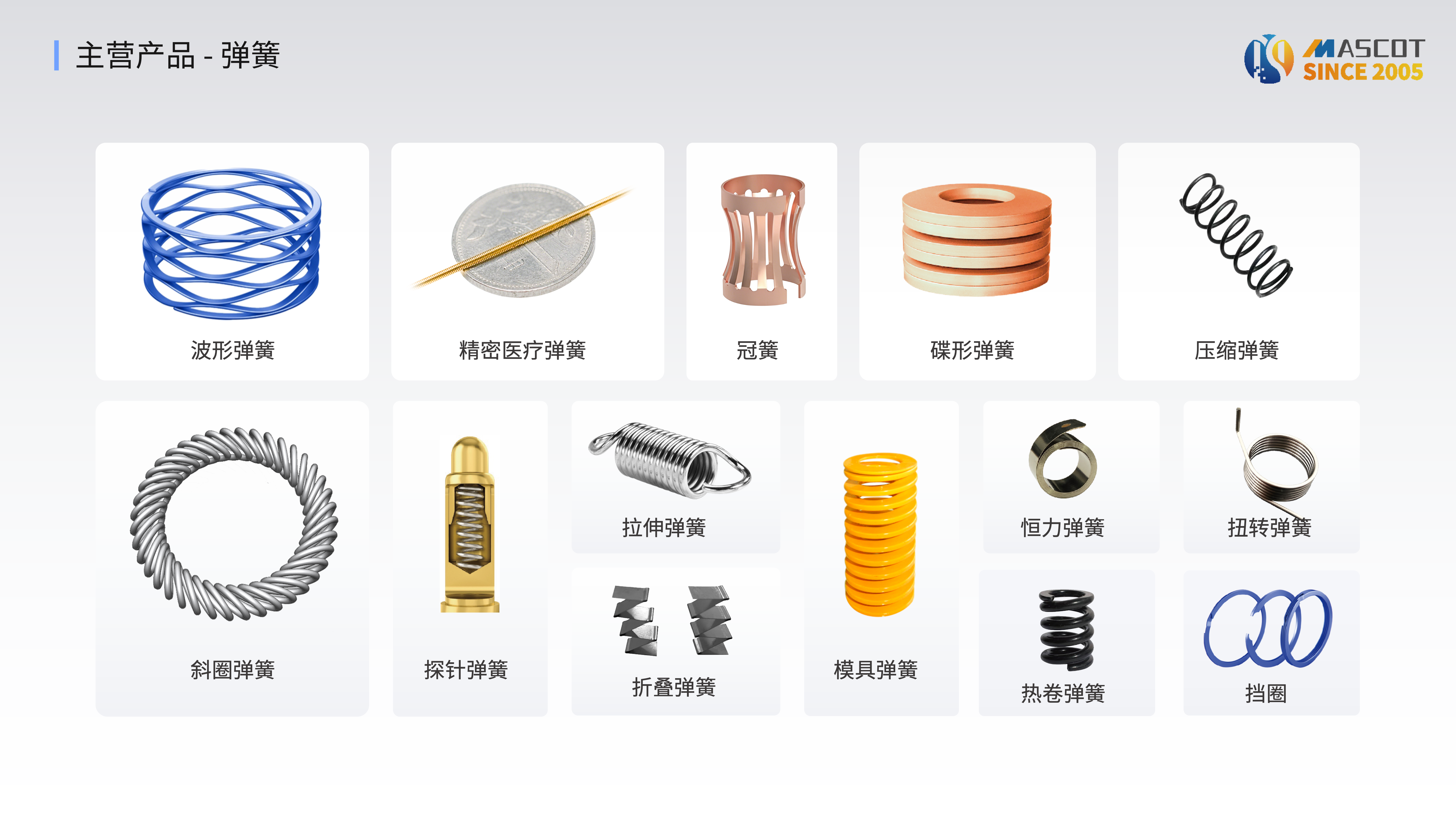
I. Main Spring Types and Core Properties for Low-Altitude Economy Industry
UAVs and eVTOL aircraft impose core requirements on springs: lightweight yet high tensile strength, high elastic modulus, high-frequency fatigue resistance, temperature & corrosion resistance, and low/non-magnetic property for certain applications. The mainstream spring types and their respective characteristics are listed below:
|
Spring Type |
Core Characteristics |
Applicable Load |
Typical Material |
| Compression Spring |
Axial load bearing, high stiffness, superior energy absorption, impact resistance |
Medium & High Load (landing impact, equipment damping) |
300M high-strength steel, TC4 Titanium Alloy, Inconel 718 |
| Torsion Spring |
Precise torque output, angular reset, anti-torsion fatigue |
Light & Medium Load (gimbal adjustment, hatch reset) |
72A/82B high carbon steel, 304 stainless steel |
| Extension Spring |
Constant tension traction, stable reset, low creep |
Light Load (latch reset, mechanism traction) |
316 stainless steel, SWP piano wire |
| Disc Spring |
Short stroke, high load capacity, stackable design, high energy storage |
Ultra-high Load (main landing gear, heavy-duty buffering) |
50CrVA, Titanium Alloy |
| Metal Rubber Spring |
Large damping capacity, wide temperature resistance (-60℃~250℃), aging resistance |
Micro-vibration isolation (flight controller, sensors) |
Stainless steel wire, nickel alloy wire |
| Leaf/Spiral Spring |
Integral forming, stable elasticity, excellent space adaptability |
Structural support, folding reset (arm, cabin door) |
65Mn spring steel, Titanium Alloy |
II. UAV Sector: Six Core Application Scenarios (with Operating Data & Working Conditions)
Spring applications for consumer, industrial and military UAVs focus on lightweight design and adaptability to high-frequency dynamic loads. A single UAV is equipped with approximately 5 to 15 springs. Details of core scenarios are as follows:
1. Landing Gear Buffering System (Core Application)
⚬Applicable components: Main landing gear struts, leg buffers, axle shock absorbers
⚬Spring types: Compression springs (dominant), disc springs (for heavy-lift industrial UAVs), metal rubber springs (for premium-grade UAVs)
⚬Working parameters: Landing impact load reaches 2.5–3 times the static load; vertical landing speed stands at 3–5 m/s for consumer UAVs and 6–8 m/s for industrial UAVs with 5–20 kg payload; impact frequency ranges from 10 to 20 Hz
⚬Functions: Absorb landing impact energy to avoid fuselage cracking and damage to cameras/sensors; reduce taxiing vibration and improve takeoff & landing stability
⚬Case study: DJI Mavic series adopts stainless steel compression springs combined with rubber composite buffering, tolerating vertical landing at 3 m/s with a service life of ≥5,000 cycles. Crop-spraying UAVs (15 kg payload) use 50CrVA compression springs featuring corrosion and fatigue resistance for muddy and uneven terrains.
2. Gimbal Stabilization & Camera Position Adjustment
⚬Applicable components: Gimbal torsion reset mechanisms, fine-tuning assemblies for camera angles, shock-absorbing hangers
⚬Spring types: Torsion springs (core part), extension springs, miniature compression springs
⚬Working parameters: Operating temperature: -20℃ ~ 60℃; torsion swing: ±30°; actuation frequency: 5–10 Hz; allowable torque tolerance: ±5%
⚬Functions: Counteract angular offset caused by flight tilt and vibration; enable automatic pitch/roll reset of cameras; isolate motor vibration (amplitude ≤0.1 mm) to guarantee aerial photography quality
⚬Case study: Consumer UAV gimbals employ high-carbon steel torsion springs with single-spring torque of 0.5–2 N·mm and service life ≥10,000 cycles. Inspection industrial UAV gimbals use titanium-alloy torsion springs cutting weight by 30% with superior corrosion resistance for coastal and chemical industry environments.
3. Arm Folding & Locking Mechanism
⚬Applicable components: Foldable arm latches, unfolding reset springs, lock pin reset assemblies
⚬Spring types: Extension springs, torsion springs, leaf springs, spiral springs
⚬Working parameters: Fold/unfold cycle ≥2,000 times; locking pulling force: 5–15 N; requirement for accurate reset without jamming
⚬Functions: Facilitate compact storage (40%–60% volume reduction after folding); enable rapid unfolding and locking at launch/takeoff; prevent unintended expansion during transportation
⚬Case study: Switchblade loitering munition UAV uses torsion springs to spread wings within 0.1 second post-launch with locking accuracy ±1°. Consumer foldable UAVs are fitted with stainless steel extension springs delivering 8–12 N unfolding force and reset time ≤0.5 s.
4. Power System Vibration Damping (Motor / ESC / Battery)
⚬Applicable components: Motor base damping pads, ESC fixing brackets, battery clamping assemblies
⚬Spring types: Miniature compression springs, metal rubber springs, silicone composite springs
⚬Working parameters: Motor vibration frequency: 100–500 Hz; vibration amplitude: 0.2–0.5 mm; operating temperature: -40℃ ~ 85℃
⚬Functions: Cut high-frequency motor vibration transmission ratio by ≥80% to avoid drift of flight controller and gyroscope; prevent battery loosening and falling off for stable power supply
⚬Case study: Multi-rotor UAV motor bases adopt metal rubber springs with 50% longer service life and wider working temperature range (-50℃ ~ 200℃) compared with conventional rubber.
5. Cargo Release & Throwing Mechanism (Logistics / Crop Protection / Military)
⚬Applicable components: Cargo clamping structures, thrower reset springs, hook release assemblies
⚬Spring types: Extension springs, compression springs, torsion springs
⚬Working parameters: Clamping force:10–50 N; release response time ≤0.2 s; service cycles ≥1,000 times
⚬Functions: Enable precise cargo drop by spring-driven gripper opening on logistics UAVs; auto-close medicine tank caps for agricultural UAVs; eject decoys and ammunitions for military UAVs
⚬Case study: 5 kg payload logistics UAV release structure adopts dual extension springs with 20 N clamping force and 0.15 s response time for courier parcel and medical supply delivery.
6. Micro-Vibration Isolation for Flight Controller & Sensors
⚬Applicable components: Shock-absorbing bases for flight control mainboard, GPS antenna brackets, gyroscope fixing assemblies
⚬Spring types: Miniature metal rubber springs, precision compression springs
⚬Working parameters: Vibration frequency:50–200 Hz; low damping and high stability required to avoid signal interference
⚬Functions: Restrict fuselage vibration transmissibility ≤10% to ensure accurate flight control data and steady GPS signal; limit gyro drift error ≤0.1°/h
III. eVTOL Sector: Five Core Application Scenarios (with Operating Data & Working Conditions)
Manned/cargo-carrying eVTOL falls under aviation-grade products with far stricter requirements on spring safety, reliability and service life versus regular UAVs, with 20–50 springs installed per aircraft. Key scenarios are listed below:
1. Main Landing Gear Buffering System (Safety Core)
⚬Applicable components: Main landing gear struts, nose landing gear shock absorbers, wheel axle buffering assemblies
⚬Spring types: Titanium-alloy compression springs (dominant), disc springs (for heavy-duty models), metal rubber springs (auxiliary damping)
⚬Working parameters: Landing impact load = 3–3.5× static load; manned aircraft landing speed:5–7 m/s; impact frequency:5–15 Hz; service life ≥10,000 landing cycles; operating temperature: -55℃ ~ 120℃
⚬Functions: Support 2–5 ton airframe weight of manned eVTOL and absorb extreme impact energy; prevent landing gear fracture and fuselage disintegration; lower landing noise and improve passenger comfort
⚬Case study: A tilt-rotor eVTOL uses TC4 titanium compression springs achieving 40% weight reduction against steel alternatives, tensile strength of 900 MPa and fatigue life ≥15,000 cycles. Stacked disc spring sets integrated on main landing gear withstand overload up to 3.5g and extend maintenance interval by 50%.
2. Rotor / Ducted Fan System (Power Stability)
⚬Applicable components: Rotor pitch-varying mechanisms, ducted fan damping supports, blade reset assemblies
⚬Spring types: Torsion springs, precision compression springs, titanium-alloy leaf springs
⚬Working parameters: Rotational speed:1,500–3,000 rpm; vibration frequency:25–50 Hz; pitch adjustment range ±15°; service life ≥20,000 operating hours; non-magnetic property required to avoid flight control interference
⚬Functions: Keep rotor pitch precision within ±0.5°; isolate engine vibration to stabilize power output; quickly reset blades upon failure to avert secondary accidents.
3. Cabin Door / Emergency Exit (Safety Actuation)
⚬Applicable components: Auto-opening springs for cabin doors, emergency exit latch reset assemblies, door closing buffers
⚬Spring types: Extension springs, torsion springs, spiral springs
⚬Working parameters: Opening pulling force:30–80 N; response time ≤0.3 s; service cycles ≥5,000 times; heat resistance: -40℃ ~ 150℃
⚬Functions: Lock cabin doors tightly during normal flight; drive automatic door opening upon power cut or malfunction for passenger evacuation; cushion closing movement against collision damage.
4. Flight Control / Avionics System (Precision Stabilization)
⚬Applicable components: Shock bases of flight control computer, IMU mounting brackets, precision sensor isolation assemblies
⚬Spring types: Metal rubber springs, miniature titanium-alloy compression springs
⚬Working parameters: Vibration frequency:50–300 Hz; damping ratio:0.1–0.3, vibration transmissibility ≤5%; operating temperature: -60℃ ~ 180℃; service life ≥30,000 hours
⚬Functions: Block high-frequency vibration from engines and rotors to secure precise data of IMU, GPS and radar; prevent loose or detached electronic components from vibration.
5. Emergency Parachute Safety System
⚬Applicable components: Parachute deployment springs, pack latch reset assemblies, traction springs
⚬Spring types: High-tension extension springs, torsion springs
⚬Working parameters: Deployment pulling force:50–100 N; trigger response ≤0.1 s; temperature resistance: -50℃ ~ 200℃; high energy storage and instant release required
⚬Functions: Instantly eject parachute when eVTOL loses control or power to limit descending overload below 2g for crew safety; lock parachute pack to avoid unintended deployment during storage.
IV. Core Material Selection & Industrial Standards (Data Supported)
Springs deployed in low-altitude economy need lightweight construction, high tensile strength, fatigue resistance and adaptability to harsh environments. Key materials and specifications as below:
1. Titanium Alloy (TC4/TA18): Core Material for eVTOL
⚬Density:4.5 g/cm³ (60% of steel); tensile strength:800–1100 MPa; fatigue limit:50%–60% of tensile strength vs ~40% for steel; working ⚬temperature: -55℃ ~120℃, non-magnetic
⚬Application: eVTOL landing gear, rotor assemblies, passenger cabin doors; critical parts of premium industrial UAVs
⚬Advantages: 30%–40% weight reduction, 50% longer fatigue life, compliant with civil aviation safety specifications for manned aircraft
2. 300M High-Strength Steel: Dominant for UAV & Auxiliary for eVTOL
⚬Density:7.85 g/cm³; tensile strength:1,800–2,000 MPa; fatigue limit ≥700 MPa; operating temperature: -40℃ ~80℃
⚬Application: UAV landing gear and motor damping; non-critical structural springs for eVTOL
⚬Advantages: Cost-effective, high mechanical strength, mature processing suitable for mass production of industrial UAVs
3. Metal Rubber (Stainless Steel Wire): Preferred for Precision Damping
⚬Density:3–5 g/cm³; damping ratio:0.2–0.5; working temperature: -60℃ ~250℃, anti-aging, corrosion-proof and non-magnetic
⚬Application: Micro-vibration isolation for flight controllers, sensors and IMU modules
⚬Advantages: 3–5 times longer service life than conventional rubber, suitable for extreme temperature and high-frequency vibration conditions
4. SWP Piano Wire / High-Carbon Steel (72A/82B): Mainstream for Miniature Springs
⚬Density:7.8 g/cm³; tensile strength:2,000–2,500 MPa; elastic modulus:200 GPa, low cost
⚬Application: UAV gimbals, small latches, miniature damping assemblies
⚬Advantages: Excellent elasticity, high dimensional precision and easy machining for mass production of consumer UAVs
Industrial Standards
⚬UAV: GB/T 38947-2020 General Requirements for Civil Unmanned Aircraft System; minimum service cycles ≥5,000 for landing gear springs and ≥10,000 for gimbal springs
⚬eVTOL: Refer to CCAR-21 and FAA Part 23 aviation standards; ≥10,000 landing cycles for landing gear springs, ≥20,000 operating hours for avionics springs, minimum safety factor ≥1.5
V. Industry Trends & Conclusion
Industry Trends
Material upgrading: Rising adoption rate of titanium alloy and metal rubber; ongoing R&D on carbon-fiber-reinforced composite springs for further weight reduction and extended service life.
Structural integration: Combined assembly of springs with hydraulic and electromagnetic dampers to build hybrid active-passive damping systems for higher impact load capacity.
Precision miniaturization: Growing market demand for micro-springs (wire diameter ≤1 mm) and high-precision torque springs matching miniaturized intelligent UAV/eVTOL development.
Conclusion
Springs serve as irreplaceable precision foundational components across the low-altitude economy. UAV spring design prioritizes lightweight property, high-frequency adaptability and cost control, while eVTOL springs focus on manned safety, harsh environment tolerance and long service lifespan. From landing buffering and flight stabilization to mechanical folding and emergency protection, springs run through full flight cycles and directly determine aircraft safety, stability and cruising efficiency. Accelerated commercialization of low-altitude economy fuels the spring industry’s shift toward high-end, precision-oriented and material innovative development, supplying core component support for the trillion-yuan low-altitude industrial market.

 Tiktok

 Kwai

 REDnote


