The rapid advancement of advanced semiconductor processes (3nm and below) and explosive growth of high-computing AI clusters are driving manufacturing equipment toward ultrahigh precision, superior cleanliness, enhanced heat dissipation efficiency and extended service life. As invisible foundational components, springs are widely deployed across four core application fields: semiconductor chip testing, wafer fabrication, AI liquid cooling and precision motion control, serving as critical enablers for stable equipment operation and improved production yield. Supported by authoritative industry statistics and field engineering practices, this article elaborates on mainstream spring varieties, application scenarios and corresponding technical specifications.
I. Industry Landscape: Surging Demand Featuring High Growth, High Technical Barriers and Strict Reliability Requirements
1. Market Size
- Semiconductor test probe springs: The global market reached USD 6.791 billion in 2025 and is projected to hit USD 7.222 billion in 2026, representing a Compound Annual Growth Rate (CAGR) of 7.05% from 2026 to 2032.
- China’s probe spring market: Valued at CNY 2.136 billion in 2025 with a forecast of CNY 2.52 billion for 2026; semiconductor testing accounts for CNY 1.23 billion of the total, while the 3nm/HBM testing sub-sector boasts a 24.5% year-on-year growth rate.
- Precision springs for AI liquid cooling: A single AI server cabinet consumes 50–120kW of power, with liquid cooling penetration exceeding 60%. The global relevant market is expected to surpass CNY 4.5 billion in 2026 at an annual growth rate above 30%.
- Premium product pricing threshold: Special-purpose springs for semiconductor and AI industries command a 40%–60% price premium over conventional industrial springs, subject to core specifications: dimensional tolerance ±0.01mm, fatigue life ≥1,000,000 cycles, contact resistance <50mΩ and operating temperature ranging from -45°C to 150°C.
-
2. Core Industry Entry Barriers
Leading manufacturers including TSMC, NVIDIA and Inspur impose mandatory supplier requirements as follows:
- Compliance with IATF16949 certification and ISO14644 cleanroom qualification;
- 100% full-inspection of finished products with key dimensional accuracy controlled at micron level;
- Minimum service life of 1,000,000 cycles for testing springs, rising to 5,000,000–100,000,000 cycles for advanced-process production lines;
- Compatibility with harsh operating conditions: non-magnetic property, low creep rate, ultra-high cleanliness and outstanding corrosion resistance.
-
II. Four Core Application Fields: Spring Types, Applications and Technical Specifications
1. Chip Testing: Micro Precision Springs – The First Line of Defense for Production Yield
Chip testing (wafer-level, packaging-level and board-level testing) directly determines final product yield. Springs deployed here feature miniaturization, low contact force, excellent electrical conductivity and ultra-long service life to fit fragile bonding pads used for 3nm and below node processes.
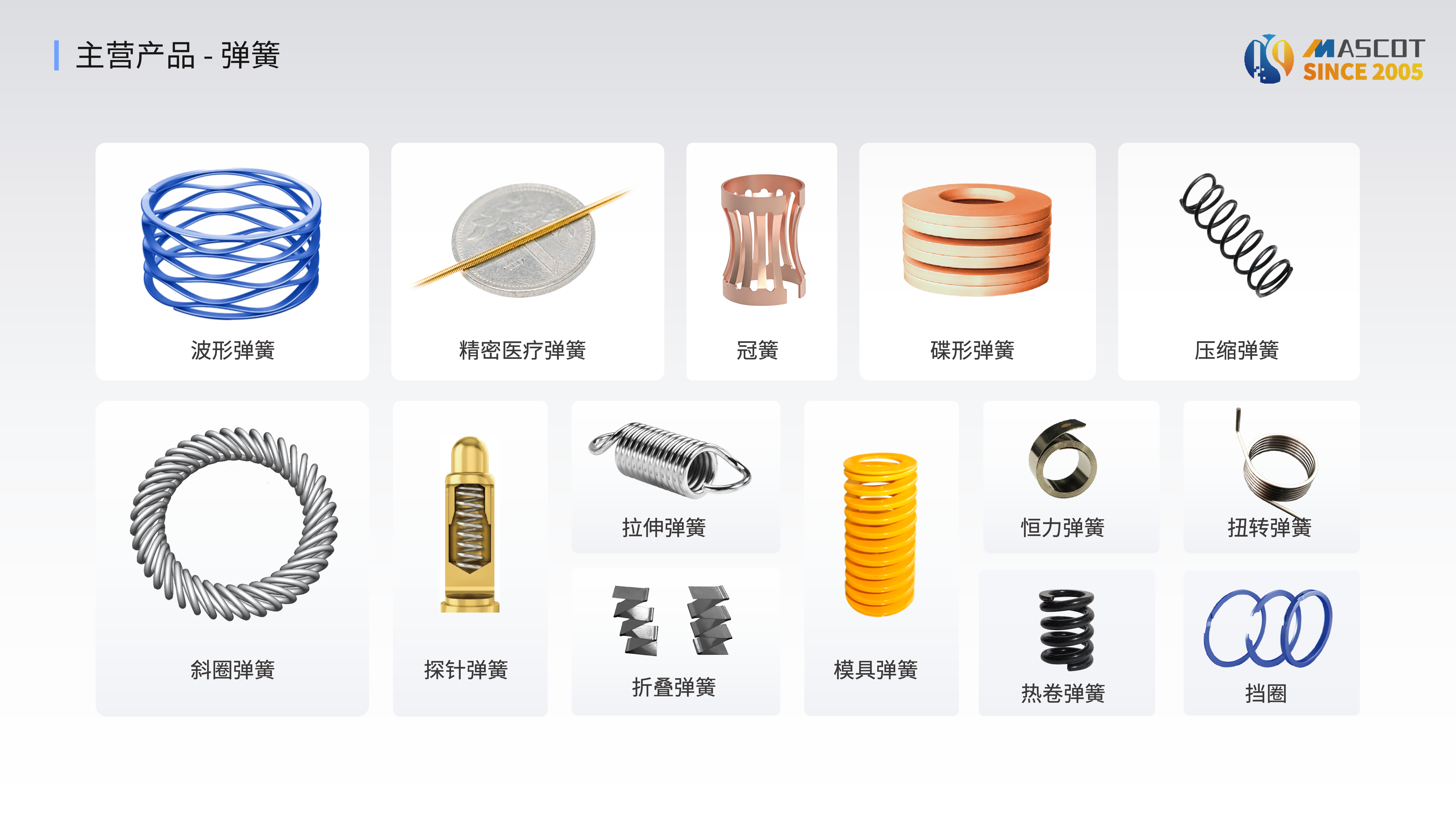
(1) Probe Springs (Cup Springs / Micro Compression Springs)
- Application: Core parts for probe cards, vertical probes and MEMS probes, delivering stable contact force of 5–20g for pad pitches between 0.15mm and 1mm.
- Specifications: Wire diameter 0.08–0.3mm, contact resistance <50mΩ, service life ≥1,000,000 cycles and consistent performance from -45°C to 150°C.
-
(2) Canted Coil Springs
- Application: Contact fingers for HBM high-bandwidth memory testing and high-frequency connectors, responsible for high-current conduction (50–200A) and elastic dimensional compensation.
- Specifications: Gold/nickel plated coating to restrict contact resistance ≤5mΩ, anti-vibration property, lifespan ≥1,500,000 cycles and adaptability for 100GHz high-frequency signal transmission.
-
2. Wafer Fabrication: High-Precision Springs for Nanometer-Scale Manufacturing
Wafer fabrication processes (photolithography, etching and thin-film deposition) are extremely vibration-sensitive; lithography equipment achieves alignment accuracy down to 0.1nm. Applied springs require superior vibration damping, low creep, non-magnetism and high cleanliness.
(1) Wave Springs
- Application: Preloading for lithography lens assemblies, wafer stage bearings and etcher fixture positioning; cuts axial installation space by 50% while providing uniform preload force.
- Specifications: Fabricated from non-magnetic stainless steel or high-temperature superalloy; ≥98% spring force retention at 120°C, preload tolerance ±3% and service life ≥500,000 cycles.
-
(2) Precision Compression Springs
- Application: Shock absorption for wafer transfer robotic arms and positioning of vacuum suction cups to avoid costly wafer collision damage (a single finished wafer is worth over CNY 100,000).
- Specifications: Mirror polishing plus vacuum degreasing to meet Class 100 cleanroom standards; >95% consistency of force-displacement curve and fatigue life ≥800,000 cycles.
-
(3) Air Springs (Vibration-Isolation Springs)
- Application: Base vibration isolation for lithography tools and electron beam lithography systems to filter external vibration above 20Hz, which otherwise causes circuit pattern offset.
- Specifications: Three-dimensional vibration isolation with nanometer-level amplitude control, isolation efficiency >95% and negligible creep under long-term static load.
-
3. Liquid Cooling for AI Servers: High-Pressure Sealing Springs Safeguarding High-Density Computing Infrastructure
With single-cabinet power draw ranging 50–120kW, liquid cooling has become the mainstream thermal management solution for AI servers. Springs are fitted into quick-disconnect couplings, pressure relief valves and sealing compensation structures to eliminate coolant leakage that may incur economic losses exceeding tens of millions RMB per incident.
(1) Canted Coil Springs (Sealing & Locking Function)
- Application: GPU cold plate locking mechanisms and liquid cooling quick connectors, implementing dynamic sealing under 10–30bar working pressure and compensating for thermal expansion gaps.
- Specifications: Specialized stainless steel substrate coated with fluororubber for resistance to ethylene glycol and deionized water; ≥80,000 plug-unplug cycles and zero leakage rate.
-
(2) Disc Springs
- Application: Sealing assemblies of liquid cooling pumps and pressure regulating valves to absorb frequent pressure shocks and dynamically compensate assembly clearances.
- Specifications: Imported high-performance alloy steel, fatigue life ≥1,000,000 cycles and stable performance between -40°C and 120°C.
-
(3) Precision Torsion Springs
- Application: Liquid cooling valve control and flow adjustment mechanisms for precise opening-angle regulation.
- Specifications: Dimensional tolerance ±0.01mm, torque tolerance ±2%, ≥100,000-cycle service life and compact footprint for dense piping layout.
-
4. Precision Motion Control & High-Voltage Connection: Miniature/High-Strength Springs Enabling Stable Equipment Operation
Semiconductor equipment and auxiliary AI server components for transmission, power distribution and automated control rely on miniaturized, high-precision and high-reliability springs to guarantee efficient system running.
(1) Micro Coil Springs
- Application: Preloading of precision drive gears, sensor positioning and compression for high-voltage contactor terminals.
- Specifications: Wire diameter 0.1–1mm, force tolerance ±3%, ≥500,000-cycle lifespan and operating range of -40°C to 120°C.
-
(2) Retaining Rings / Circlips
- Application: Shaft positioning, bearing fixation and pipeline limiting on semiconductor and liquid cooling equipment against loose displacement.
- Specifications: ±0.01mm dimensional tolerance, burr-free finish, anti-vibration and cleanroom-compliant construction.
-
III. Mascot Technology: Full-Spectrum Custom Spring Solutions for Semiconductor & AI Computing Industries
1. Corporate Strength: Two Decades of Expertise with Global Intelligent Manufacturing Layout
Founded in 2005, Mascot Technology is a Sino-foreign joint venture specializing in precision elastic component manufacturing. The firm operates four smart manufacturing bases in Taicang, Shaoxing, Dallas (USA) and Chonburi (Thailand), staffed by 398 employees including 168 R&D engineers with over 1,000 sets of production equipment. Certified to IATF16949 standards, Mascot has focused on precision spring development for 20 years, covering wave springs, canted coil springs, probe springs, disc springs and micro springs with available wire diameters spanning 0.01mm to 20mm for fully customized development across all application scenarios.
2. Core Competitive Advantages Addressing Key Industry Pain Points
- Micron-level precision fabrication: Imported CNC production equipment with inspection accuracy down to 0.01mm plus 100% full finished-product inspection to match requirements of 3nm advanced processes.
- Outstanding thermal stability in extreme conditions: Gradient tempering and vacuum heat treatment ensure ≥98% spring force retention from -45°C to 150°C.
- High-conductivity & non-magnetic material portfolio: High-elastic alloys, non-magnetic stainless steel and gold/nickel plating options deliver low contact resistance and zero magnetic interference.
- Superior anti-fatigue durability: Optimized coiling processes eliminate stress concentration, extending maximum service life up to 100 million cycles.
-
3. Customized Engineering Service
Application-specific spring designs are delivered within 72 hours per client’s operating parameters including temperature, pressure, vibration, installation space and electrical current; prototype samples available in 7 days and mass production completed within 15 days with full-cycle technical after-sales support.
IV. Industry Trends & Future Outlook
- Performance upgrading: Next-generation springs will target ≥5,000,000-cycle service life, operating temperature coverage of -50°C to 180°C, contact resistance ≤3mΩ and full non-magnetic property to adapt to 2nm chip processes and higher-power liquid cooling systems.
- Miniaturization & integrated design: Mass adoption of springs thinner than 0.08mm wire diameter, pre-integrated with probes, sealing elements and sensors to simplify final assembly.
- Material innovation: Titanium alloy, carbon-fiber composites and amorphous alloys will see scaled commercial application to elevate component performance and extend service lifespan.
-
Conclusion
Booming expansion across the semiconductor and high-performance AI computing sectors creates tremendous market opportunities for precision springs alongside stringent technical thresholds. Drawing on 20 years of proprietary technology accumulation, worldwide smart manufacturing footprint and tailor-made customer service, Mascot Technology supplies micron-precision, long-life and environment-resistant springs to empower reliable and efficient operation of chip testing, wafer fabrication and AI liquid cooling systems, facilitating high-quality sustainable growth of the whole industrial chain.

 Tiktok

 Kwai

 REDnote


