Foldable Spring: The Precision Core for Torsional Damping of Automotive Clutches
Source: Website
In automotive transmission systems, the clutch is a core component for engaging and disengaging power. Foldable springs (officially named: clutch torsional damper spring leaf / multi-layer steel leaf damper spring) serve as key elastic parts for driven discs and dual mass flywheels (DMF). Featuring compact axial dimension, non-linear stiffness, high vibration damping efficiency and excellent fatigue resistance, they have become the mainstream damping solution for clutches in hybrid vehicles, dual-clutch transmissions and high-end fuel-powered vehicles, directly influencing transmission smoothness, NVH performance and long-term reliability.
I. Core Positioning: Flexible Buffer Unit for Clutch Torsional Damping
Foldable springs are installed in the damper windows of clutch driven discs or between the primary and secondary sections of dual mass flywheels. Generally 2 to 4 sets are arranged circumferentially, forming a multi-stage torsional damping system together with damping plates.
Core Functions
Absorb torque impact: Filter torque fluctuations caused by rapid acceleration, gear shifting and idling, and reduce impact loads on the transmission system.
Suppress torsional vibration: Restrain torsional vibration generated by the reciprocating motion of the engine, so as to avoid gear rattle and premature bearing wear.
Improve engagement smoothness: Deliver gradual elastic deformation for softer clutch engagement and reduced jerk during vehicle start-up and gear shifting.
Save axial space: The flat folded structure features an axial thickness around one-third of conventional coil springs, well suited for the compact layout of hybrid vehicles and DCTs.
II. Structure & Working Principle: Elastic Design of Multi-layer Folded Steel Leaves 1. Structural Features
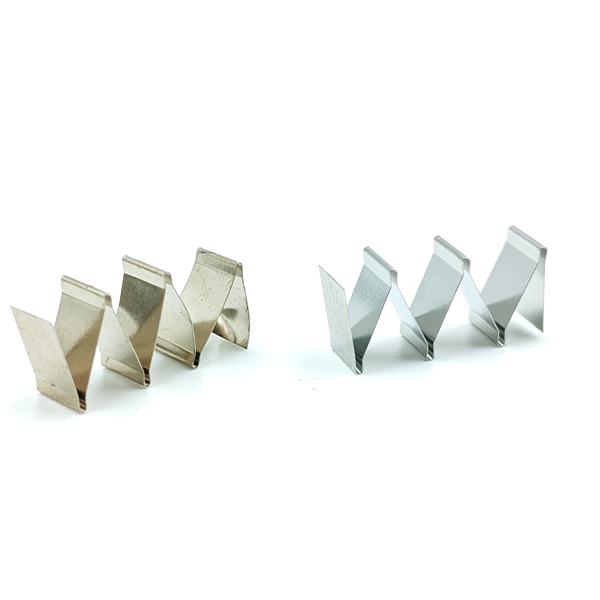
Foldable springs are manufactured from high-elastic alloy steel strips through precision stamping, folding and heat treatment, presenting a continuous wave or Z-shaped laminated structure.
Steel strip thickness: 0.3–1.0 mm
Number of folded layers: 6–12
Mainstream materials: Alloy spring steels such as 60Si2MnA, 50CrVA and 55SiCr, complying with GB/T 1222-2016
Materials for severe working conditions (hybrid / heavy-load applications): High silicon-chromium-vanadium steels including SWOSC-V and SAE9254, with tensile strength ≥ 1800 MPa
Surface treatments: Phosphating, shot peening, chromium-free passivation and PVD coating to enhance wear resistance and fatigue performance.
2. Working Principle
When engine torque is transmitted from the flywheel to the driven disc, circumferential torque triggers relative sliding between layers and overall elastic deformation of the foldable spring.
Low torque (idling / constant speed): Minor deformation filters high-frequency micro-vibration and keeps the transmission running steadily.
Medium to high torque (acceleration / climbing): Multiple layers bear loads progressively, and the stiffness rises non-linearly with deformation to effectively absorb severe impact torque.
Reverse operating condition (coasting / braking): Work with damping plates to suppress reverse impact and protect the transmission and bearings.
Compared with conventional coil springs: It achieves more uniform stress distribution without obvious stress concentration, resulting in greatly improved fatigue life.
III. Advantages over Conventional Coil Springs
1. Higher Space Utilization
Axial dimension reduced by 50%–70%.
More compact radial layout, ideal for the limited installation space of DCTs and P2/P3 hybrid systems.
2. Superior Vibration Damping & NVH Performance
Non-linear stiffness: Soft under light loads and rigid under heavy loads, balancing smooth idling and heavy-load capacity.
Interlayer friction damping: Higher damping capacity and faster torsional vibration attenuation than pure coil springs, delivering notable improvement in NVH performance.
3. Longer Fatigue Life (Field-tested Range)
Conventional coil spring (65Mn): 300,000–500,000 cycles
Standard foldable spring (60Si2MnA): 600,000–800,000 cycles
High-grade foldable spring (50CrVA/55SiCr): 800,000–1,000,000 cycles (complying with JB/T 12792-2016)
4. Lightweight & Excellent Consistency
Weight reduced by 30%–40% compared with coil springs of equivalent functions.
Integral stamping forming ensures the stiffness deviation within ±5% in mass production, with better consistency than traditional assembled springs.
IV. Main Application Scenarios
1. High-end Fuel-powered Vehicles (AT/MT)
Vehicles with displacement of 2.0T and above and torque ≥ 350 N·m.
Replace traditional short circumferential coil springs to solve fracture and abnormal noise issues under high torque.
Widely applied to European class-B sedans, domestic high-end SUVs and certain performance vehicles.
2. Hybrid Vehicles (PHEV/HEV, Fastest-growing Market)
Compatible with DM-i, Leishen, range-extended and P2 hybrid architectures.
The start-stop frequency of hybrid engines is 3 to 5 times higher than that of traditional fuel engines, imposing stricter requirements on spring fatigue life and thermal relaxation resistance.
Thanks to long service life, high temperature resistance and compact size, foldable springs have become the preferred choice for clutches and dual mass flywheels of hybrid vehicles.
3. Dual-Clutch Transmissions (DCT)
Applied for vibration damping on driven discs of dry and wet 7DCT/8DCT.
Alleviate low-speed jerk, start-up abnormal noise and gear shift impact.
Massively supplied to major domestic DCT manufacturers.
V. Industry Status & Technical Trends
1. Market Scale
Overall market size of automotive clutch springs (including pressure plate springs, driven disc springs and damper springs) in China in 2025: Approximately 15 billion RMB (comprehensive industrial estimation).
Market size of driven disc damper springs (including foldable springs): Approximately 4–5 billion RMB.
Market share of foldable springs among damper springs: About 20%–30%, rising year by year driven by hybrid vehicles and DCTs.
Growth rate: High-value-added springs for hybrid vehicles register a growth rate of 8%–12%, higher than 3%–5% for springs used in traditional fuel vehicles.
2. Material Upgrading Trend
The traditional 65Mn steel is gradually phased out from high-end applications.
The application proportion of 55SiCr, SAE9254 and 50CrVA keeps increasing. The penetration rate of high silicon-chromium-vanadium steels reached around 40% in 2025.
In a small number of hybrid and special vehicles working under extreme high-temperature and heavy-load conditions, Inconel 718 is adopted occasionally. It is not a standard material with a penetration rate below 5% and high costs.
3. Manufacturing & Precision Standards (In accordance with national & industrial standards)
Dimensional tolerance: Steel strip thickness ±0.01 mm, length / width ±0.02 mm (GB/T 1239.2-2021).
Surface roughness: Ra 0.8–1.6 (up to Ra 0.4 for premium products).
Fatigue standard: JB/T 12792-2016 requires a service life of no less than 500,000 cycles; high-end hybrid vehicle clients generally set the requirement above 800,000 cycles.
Intelligent manufacturing: Leading manufacturers adopt numerical control stamping, AI full visual inspection and shot peening strengthening, controlling the defective rate below 100 ppm.
VI. Conclusion
With four core strengths — compact size, high damping, long service life and light weight, foldable springs have become a mainstream upgraded solution for clutch torsional damping, with rising penetration in hybrid vehicles, DCTs and high-end fuel-powered vehicles. The industry is evolving from low-cost general-purpose production to high-grade materials, precision manufacturing and long-lifetime performance. Domestic substitution is advancing steadily, while gaps still exist in the high-end market.
Far from being trivial parts, foldable springs are critical precision elastic components that determine the smoothness, reliability and durability of transmission systems in the hybrid era.


 Tiktok

 Kwai

 REDnote


