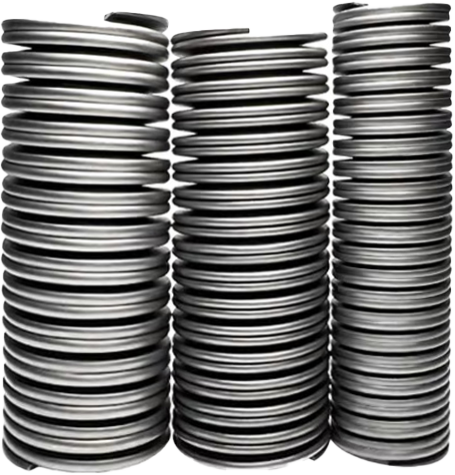
Driven by the rapid development of high-end equipment manufacturing, new energy, aerospace and other industries, double helical springs, as core elastic components, are accelerating their shift toward high-end development. Evolving from conventional general parts, they have gradually developed into high-end functional components featuring high precision, superior reliability and intelligence. This article comprehensively analyzes the upgrading and development status of double helical springs from three perspectives: technological innovation, industry landscape and practical applications.
I. Core Transformations in the High-end Upgrade of Double Helical Springs
The overall upgrade of double helical springs is characterized by a transition from "basic usability" to "high precision, high reliability and intelligence", covering four major aspects: materials, design, manufacturing and functions.
1. Material Upgrade: Conventional Steels Replaced by High-grade Alloys & Special Materials
Traditional products are mostly made of common spring steels such as 65Mn and 60Si2Mn, with a maximum operating temperature of 120℃ and a fatigue life of only 300,000 to 500,000 cycles, failing to meet demanding working conditions. From 2025 to 2026, major materials for the high-end market have been fully upgraded:
- Inconel 718/750 Superalloys: Operating temperature ranges from -60℃ to 280℃. Featuring excellent heat resistance, pressure resistance and corrosion resistance, they extend the service life by over 50%.
- Titanium Alloy Ti-6Al-4V: Optimized for lightweight design and high strength, it reduces product weight by more than 30% and is widely applied in the aerospace sector.
- Nitinol Shape Memory Alloy: Boasting outstanding superelasticity with a fatigue life of over 1,200,000 cycles, it is commonly used in precision equipment including medical robots and aerospace actuators.
Meanwhile, surface treatment technologies have also been upgraded. Processes such as electroless nickel-phosphorus plating, PVD coating and chromium-free passivation are widely adopted to further enhance wear and corrosion resistance, doubling the overall service life.
2. Design Upgrade: Empirical Design Transformed into Simulation Optimization & AI-powered Intelligent Design
In the past, the industry relied on manual experience and basic mechanical calculations, which often led to deflection and stress concentration. Today, digital design has become mainstream:
- Multi-physics Simulation: Software including ANSYS and ABAQUS is applied to conduct full-process optimization on stiffness, fatigue strength and resonance performance.
- Topology Optimization & Additive Manufacturing: Product weight is reduced by 22% while stiffness increases by 18% without compromising performance, enabling complex structural designs unachievable via traditional processes.
- AI Generative Design: By inputting parameters such as load, installation space and service life, the system automatically determines the optimal ratio of inner and outer springs, winding direction and preload, cutting the R&D cycle by more than 50%.
In terms of structural details, the industry widely adopts the counter-wound and high-precision coaxial design. The opposite winding directions of inner and outer springs counteract torsional torque, limiting deflection within 0.002 mm. The dual-stiffness structure is precisely calibrated: the inner soft spring works under light loads, while the outer rigid spring shares the force under heavy loads, balancing responsive performance and heavy-load capacity.
3. Manufacturing Upgrade: Traditional Machining Evolves into Micron-level Intelligent Precision Manufacturing
Processing accuracy has achieved a leap forward with all core indicators optimized comprehensively:
- Dimensional tolerance: tightened from ±0.1 mm to ±0.01 mm
- Coaxiality: improved from 0.05 mm to ≤0.005 mm
- Surface roughness: optimized from Ra3.2 to Ra0.4, greatly boosting fatigue resistance
Production technologies have also been innovated. CNC spring coiling combined with AI visual full inspection realizes 100% detection of dimensional errors and surface defects, lowering the defect rate to below 50 ppm. Digital twin and closed-loop production control systems adjust operating parameters in real time to ensure consistent quality of mass-produced products. In addition, eco-friendly processes such as induction heating and chromium-free passivation comply with the national carbon peaking and carbon neutrality goals.
4. Functional Upgrade: Pure Mechanical Components Transformed into Intelligent Sensing Units
Functional integration has become a key breakthrough in recent years. Beyond basic elastic performance, double helical springs have evolved into intelligent sensing components. Embedded fiber Bragg grating sensors enable real-time monitoring of strain (accuracy: ±10με) and temperature (accuracy: ±1℃). Combined with edge computing and wireless transmission technologies, the fault early warning accuracy reaches 94%, cutting overall maintenance costs by 35%. The maintenance mode has shifted from traditional breakdown replacement to predictive maintenance, which is favored by high-end equipment manufacturers and fully meets stringent reliability requirements.
II. Overall Industry Changes (2025-2026)
Along with technological upgrades, profound changes have taken place in the market structure, competition patterns and industrial standards of China’s double helical spring sector.
1. Restructured Market: Intense Price Competition in Low-end Segment, Accelerated Domestic Substitution in High-end Segment
In 2026, the overall market size of China’s spring industry will reach approximately 13.59 billion yuan, with a year-on-year growth rate of 6.3%. High-end precision products such as double helical springs register a growth rate of over 12%, far exceeding the industry average. Previously, more than 70% of precision springs for high-end fields including machine tools, wind power, aerospace and new energy vehicles relied on imports. Currently, leading domestic enterprises represented by Minshuo, Henglijiachuang and Huawei have obtained authoritative certifications such as IATF 16949 and aerospace-grade qualifications, accelerating the import substitution of high-end products. Industry concentration continues to rise. Small and medium-sized manufacturers focusing on low-end production are being phased out, while leading enterprises expand production capacity and actively explore overseas markets in Southeast Asia, Europe and other regions.
2. Shift in Competition Logic: From Price Competition to Comprehensive Strength Competition
The low-end market still competes mainly on unit price and production volume with shrinking profit margins. The high-end market features multi-dimensional competition and solid technical barriers:
- Material Barrier: Mastery of stable supply chains and exclusive heat treatment processes for high-end materials including Inconel alloys and titanium alloys.
- Process Barrier: Proficiency in micron-level precision machining and establishment of a full-process quality traceability system.
- Technology Barrier: Core capabilities in simulation design, AI R&D and intelligent sensing integration.
- Service Barrier: Provision of customized R&D and full-lifecycle supporting services.
-
3. Upgraded Industrial Standards: Coexistence of National Standards, International Standards & Stringent Industry Specifications
New industrial standards including JB/T 10416-2025 have been officially implemented since 2026, setting stricter requirements on fatigue life, coaxiality and material purity of springs, which directly drives the large-scale application of double helical springs in new energy vehicles and wind power. Meanwhile, clients in aerospace, high-end oil and gas equipment and other fields adopt international standards such as MIL-S-8837 for aerospace and ASTM B733 for corrosion protection, pushing the whole industry to align quality with international benchmarks.
III. Practical Application Scenarios for High-end Products
Supported by technological and quality improvements, double helical springs have been widely applied in six high-value-added high-end fields with clear operating conditions and application advantages.
1. High-end CNC Machine Tools (Most Mature & Largest Application Volume)
They are primarily used in tool clamping mechanisms of 5-axis machine tools and high-speed motor spindles. The equipment runs at 24,000 to 50,000 RPM with 10,000 tool changes per month under long-term exposure to lubricating oil and emulsifying fluid. Compared with conventional disc spring sets, double helical springs avoid misalignment and fragmentation risks. Their service life is extended from 10–14 months to more than 36 months. The annual attenuation rate of clamping force drops from 12% to less than 2%, and the positioning accuracy of equipment remains stable within 0.0015 mm. Currently, the products are supplied to international brands such as DMG MORI, Haas and Hermle, as well as leading domestic 5-axis machine tool manufacturers.
2. New Energy Vehicles (Rapid Market Growth)
The products are applied in three core parts: replacing conventional single springs in chassis suspensions to improve deflection resistance and extend fatigue life from 500,000 cycles to 800,000 cycles; serving as preload components for reducers and differentials in electric drive systems to ensure high-speed and low-noise operation; and adopting miniature double helical springs in battery modules to buffer thermal expansion and contraction as well as vibration, enhancing overall vehicle safety.
3. Offshore Wind Power (High Corrosion & Heavy Load Conditions)
Widely used in pitch control mechanisms, tower dampers and yaw brake systems of wind turbines, these products are mainly made of Inconel 750, which resists salt spray corrosion and operates steadily at temperatures from -40℃ to 180℃ with a fatigue life of over 1,000,000 cycles. Equipped with fiber-optic sensing modules, they can give early warnings of pitch jamming and damper failure, cutting operation and maintenance costs by 35%.
4. Aerospace (High Threshold & High Value-added Field)
Typical applications include high-pressure compressors and fuel control units of aero-engines, precision supporting structures for satellites and radars, as well as aerospace actuators. The products are required to withstand high temperatures, vibration and electromagnetic interference. Aerospace actuators are mostly made of nitinol to achieve miniaturization, lightweight design and long service life. The whole production process complies with MIL aerospace standards to realize zero-defect production and full-lifecycle quality traceability.
5. Oil & Gas Industry (High Temperature, High Pressure & Severe Corrosion Environment)
They are key components for blowout preventers (BOP), downhole packers and high-temperature valves in oil and gas extraction equipment. The operating environment features temperatures of 150℃ to 220℃, pressure of 70–140 MPa, and exposure to highly corrosive media such as hydrogen sulfide and brine. Products combining Inconel 718 with nickel-phosphorus coating are widely used, achieving a service life more than three times longer and gradually replacing imported disc spring assemblies.
6. Humanoid Robots (Cutting-edge Field with Small Batch & High Value)
Applied in robot joint modules, foot buffers and gripper structures, these springs are miniaturized with wire diameters of only 0.3–0.8 mm. They require fast response, low hysteresis and a fatigue life of over 1,000,000 cycles. At present, they have been put into small-batch application in products such as Unitree G1 and Ubtech Walker X.
IV. Conclusion
The high-end transformation of double helical springs is driven by four concurrent upgrades: premium materials, intelligent design, precision manufacturing and functional integration. The industry has moved away from vicious price competition toward comprehensive competition in technology, craftsmanship and services, with domestic substitution becoming a major trend.
Currently, the products are mainly deployed in six high-value-added sectors: high-end CNC machine tools, new energy vehicles, offshore wind power, aerospace, oil & gas, and humanoid robots. Featuring high stability, long service life, low maintenance costs and intelligent controllability, they continue to deliver reliable elastic solutions for high-end equipment manufacturing. With the sustained development of downstream industries, technological innovation and market potential of double helical springs will be further expanded in the future.

 Tiktok

 Kwai

 REDnote


