Structure, Features and Application of Thimble Springs
Source: Website
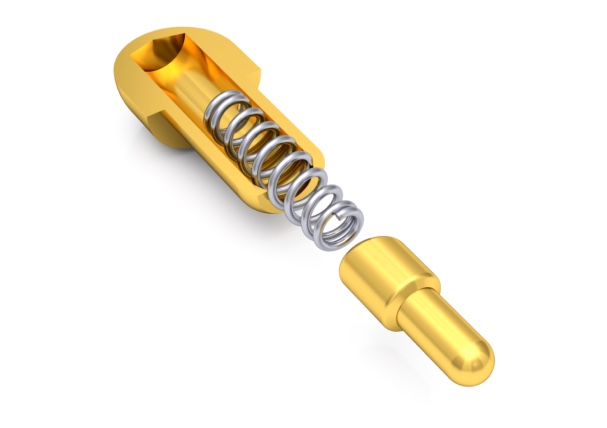
Thimble springs, also known as probe springs, PogoPin springs and test pin springs, are additionally referred to as pop-up pin springs, conductive thimble springs, miniature thimble compression springs and jig thimble springs. As the core miniature precision compression springs inside spring pins (PogoPin connectors), they are installed between the pin shaft and pin tube. Belonging to micro precision elastic components, they serve as key parts for realizing elastic contact, electrical conduction and tolerance compensation, and are widely applied in various precision electronic equipment and testing scenarios.
As the core component of PogoPin connectors, thimble springs undertake vital functions. They provide constant and uniform elastic force to ensure tight and stable contact of contact points, fundamentally avoiding signal interruption or power failure caused by poor contact. Meanwhile, they effectively compensate for height tolerances and height differences generated during the assembly of PCB circuit boards, chips and complete machines, adapting to different assembly accuracy requirements. Under working conditions such as repeated plugging, pressing and testing, thimble springs achieve high-frequency telescopic rebound and deliver cushioning and shock absorption effects, preventing damage to component contact points from rigid contact. In addition, their compact size adapts to high-density layout and saves internal installation space of equipment.
The specifications of thimble springs feature high precision and customizability, with core parameters including wire diameter, outer diameter, free length, working stroke, elastic force range, service life and precision. The wire diameter is mostly in the ultra-fine range of 0.02mm~0.3mm. The outer diameter and free length can be customized according to different PogoPin tube sizes and stroke requirements. The conventional working stroke ranges from 0.3mm to 3mm, and the elastic force is between 15g and 50g, with ultra-low and high elastic force versions available for customization. The service life varies by material: ordinary versions reach 10,000 to 50,000 cycles, while precision piano steel wire versions exceed 100,000 cycles. They feature small wire diameter tolerance, high concentricity and excellent consistency of elastic force.
The performance of thimble springs is closely related to raw materials, and four mainstream materials are widely used in the industry.
First, piano steel wire (SWP) features superior elasticity, excellent fatigue resistance, stable elastic force without attenuation and long service life, suitable for high-demand scenarios such as semiconductor testing and high-end precision connectors.
Second, stainless steel (SUS304/316) offers good corrosion resistance and rust resistance with high cost performance, commonly used in consumer electronics, home appliances and ordinary contact connection scenarios.
Third, beryllium copper or phosphor bronze provides outstanding electrical conductivity, good elasticity and oxidation resistance, ideal for precision scenarios requiring high conductivity.
Fourth, special alloy wire boasts high temperature and high pressure resistance, and can be made into ultra-fine wire diameters, applied in special fields including military industry, automotive electronics and high-end chip testing.
In terms of structural characteristics, thimble springs are manufactured by fine miniature winding technology with flat and burr-free end faces, ensuring perfect fitting with pin shafts and pin tubes. They deliver uniform and stable elastic force, high consistency in the same batch, excellent toughness, non-deformation in long-term use and sensitive rebound. Surface treatments such as gold plating, silver plating and rust prevention can be adopted to further enhance corrosion resistance and electrical conductivity. Meanwhile, customized production of non-standard sizes, elastic force and lengths is available to meet personalized demands of different industries and equipment, presenting strong adaptability.
Thimble springs have extensive application coverage across consumer electronics, circuit boards, test jigs, industrial and automotive control, and precision instruments.
In consumer electronics, they are widely used for battery contacts of mobile phones, tablets, smart wearable devices, Bluetooth earphones and smart home products.
In the circuit board field, they match PogoPin connectors on PCB boards to realize board-to-board elastic connection.
In the test jig field, they are applied to semiconductor chip testing, wafer testing and fixture test pins, ensuring stable testing performance.
In industrial and automotive control, they are used for signal and power connection of automotive electronics, industrial control and automated equipment.
In precision instruments, they are suitable for miniature elastic connection in medical equipment, precision meters, aerospace and other fields.
Compared with ordinary elastic components, thimble springs have prominent advantages:
First, ultra-compact size meets the design demands of high-density and miniaturized products.
Second, stable elastic force avoids fatigue and collapse after long-term operation with high reliability.
Third, reliable conductive contact and low impedance guarantee stable signal transmission.
Fourth, excellent stamping and plugging resistance extends service life and reduces equipment maintenance costs.
Fifth, complete specifications and customized production by drawings or samples fully satisfy diversified demands of various industries.

 Tiktok

 Kwai

 REDnote


