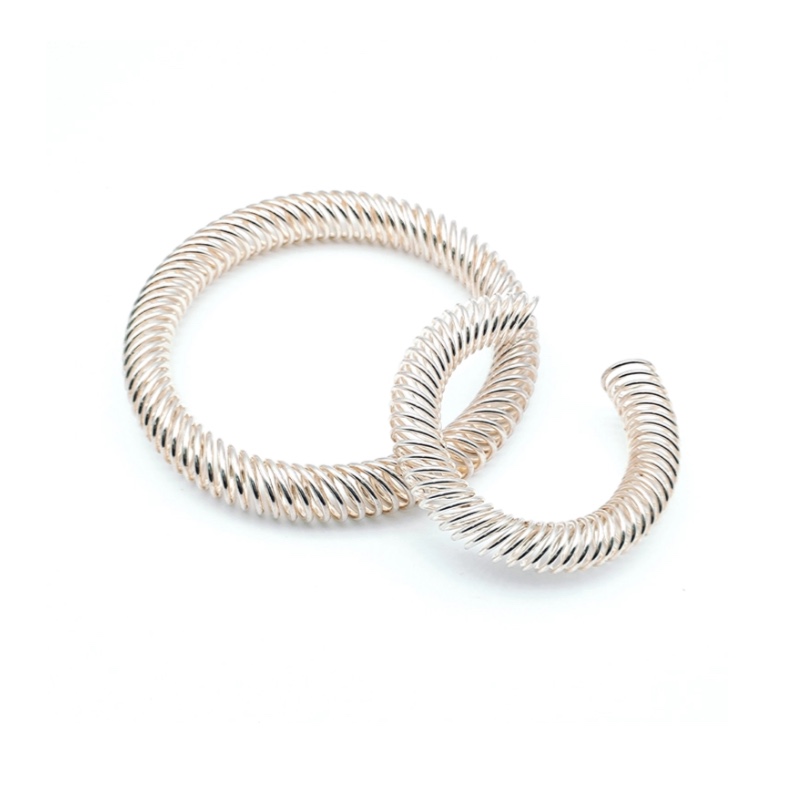
Canted coil spring, commonly known in the industry as contact finger spring, is a core precision elastic conductive component in the connector field. It is mainly installed at the contact position of connectors, performing the dual functions of elastic compression and stable electrical conduction.
Compared with traditional crown springs, leaf springs and pin springs, canted coil springs feature multi-point contact, constant force compensation and excellent vibration resistance. They have become the preferred elastic components for medium and high‑voltage, high-current, high-reliability and miniaturized connectors. Widely used in high-end connector applications such as new energy, aerospace, industrial control and military industries, they directly determine the conduction stability, service life and environmental adaptability of connectors.
1. Core Position and Function of Canted Coil Springs in Connectors
In connector structures, canted coil springs are mostly assembled inside the pin and socket contacts of plugs and receptacles, serving two core functions:
-
Elastic Compression
By utilizing the elasticity of inclined coils, it closely fits the male and female contact parts of the connector, compensating gaps caused by assembly tolerances, component wear and thermal expansion & contraction, and ensuring stable contact without loosening.
-
Stable Conduction
Through multi-point parallel contact, it reduces contact resistance and improves current-carrying capacity. It avoids overheating, arcing and signal interruption caused by poor contact, and guarantees stable transmission of electric current and signals.
Simply put, canted coil springs are the core guarantee of connector contact reliability. Especially under harsh working conditions such as vibration, high & low temperature and corrosive environments, their performance is far superior to traditional elastic contacts.
2. Core Advantages of Canted Coil Springs for Connector Applications
Connectors require elastic contacts to feature stable conduction, durable elasticity, anti-interference capability and compact size. The structural design of canted coil springs perfectly meets these requirements:
-
Multi-point parallel contact for more stable conduction
Each inclined coil acts as an independent contact point, forming a dense annular contact group. Even if individual contacts are worn, overall conduction remains unaffected, avoiding failure risks of single-point contact. Contact resistance is extremely low and stable (usually at milliohm level), with minimal signal transmission loss.
-
Constant force compensation with high tolerance
Spring force fluctuation is small within the compression stroke (less than 10% fluctuation at 30%–70% compression). It self-adapts to assembly tolerances, plug-in wear and thermal expansion & contraction of male and female connector parts, maintaining stable elasticity and contact performance during long-term service.
-
Vibration and impact resistance for harsh environments
The independent elastic coil structure effectively absorbs vibration and impact energy to prevent contact loosening. In high-vibration scenarios such as automotive, industrial control and aerospace equipment, it is much less prone to poor contact and arcing than crown springs and leaf springs, improving connector anti-interference performance.
-
Compact structure adapting to miniaturization trend
The annular design occupies little axial space and can be manufactured into ultra-thin and micro sizes. It meets the development trend of miniaturization and integration, and is especially suitable for high-density, small-size connectors such as micro aviation plugs and new energy high-voltage connectors.
-
Excellent fatigue resistance and long service life
Uniform stress distribution delivers outstanding fatigue performance. Plugging cycles can exceed 100,000 times, far outperforming conventional elastic parts. It reduces connector maintenance costs and suits long-term maintenance-free applications such as military and aerospace connectors.
-
Dual-direction elasticity adapting to complex assembly
It provides both radial and axial elastic compensation, accommodating assembly deviation such as eccentricity and misalignment between male and female contacts, lowering assembly difficulty and improving yield rate.
3. Material and Surface Treatment Selection for Connector Canted Coil Springs
Connectors operate under diverse temperatures, media and current loads. Material and surface treatment must be selected according to application scenarios, focusing on electrical conductivity, corrosion resistance and elastic durability.
3.1 Material Selection by Application Scenario
-
General medium & low-voltage connectors (industrial & civil)
Beryllium copper alloy is the first choice, featuring high conductivity, high elasticity and excellent fatigue resistance. Suitable for normal current ≤100A and temperature range -20℃~80℃, for general industrial and consumer electronic connectors.
-
Cost-effective connectors (mid-to-low end)
Phosphor copper alloy offers moderate conductivity and good elasticity at lower cost than beryllium copper. Suitable for low-voltage, small-current applications such as ordinary signal connectors.
-
Medium & high-voltage, high-current connectors (new energy & power)
High-strength beryllium copper alloy with high-temperature anti-oxidation treatment is preferred. Adaptable to current 100A~1000A and working temperature up to 150℃, widely used in new energy vehicle high-voltage connectors and power equipment connectors.
-
High-temperature and corrosive environment connectors (aerospace, military, chemical)
High-temperature alloys (Inconel) or corrosion-resistant stainless steel (316) are adopted. High-temperature alloys suit environments above 600℃ such as aerospace connectors; 316 stainless steel applies to corrosive chemical conditions.
Note: Stainless steel and high-temperature alloys have low conductivity and are only used for auxiliary elasticity rather than main current conduction. Copper alloys remain the choice for primary conductive positions.
3.2 Surface Treatment by Conductive & Protection Requirements
-
High-end precision connectors (aerospace & high-frequency signal)
Gold plating provides superior chemical stability, ultra-low contact resistance, oxidation and corrosion resistance. Ideal for high-frequency signal transmission and high-reliability requirements such as aviation plugs and precision signal connectors.
-
Medium & high-voltage, high-current connectors (new energy & power)
Silver plating delivers the best conductivity and high current-carrying capacity. Suitable for high-power transmission; the downside is vulnerability to sulfide discoloration, so sulfur-containing environments should be avoided. Typical applications include new energy vehicle high-voltage connectors and power switch connectors.
-
General-purpose connectors (industrial & civil)
Nickel plating provides basic oxidation resistance and improved surface wear resistance at low cost, suitable for low-voltage ordinary conductive scenarios such as industrial plugs and consumer electronic connectors.
-
Corrosive environment connectors (marine & chemical)
Hard chrome plating plus passivation enhances corrosion resistance and wear resistance for humid, acidic and alkaline conditions, such as marine engineering and chemical equipment connectors.
4. Main Application Scenarios of Canted Coil Springs in Connectors
Canted coil springs cover full connector categories, especially widely adopted in mid-to-high-end and harsh-condition products.
4.1 New Energy Vehicle Connectors
One of the most important application fields, adapting to high voltage, large current, vibration and wide temperature range in new energy vehicles.
-
High-voltage connectors
Used for battery pack connection, PDU, motor & electronic control connection, charging guns and charging sockets. Core requirements: current 100A~800A, low contact resistance, vibration resistance, temperature tolerance -40℃~150℃. Beryllium copper with silver or gold plating is preferred to ensure stable long-term conduction and avoid overheating risks.
-
Low-voltage signal connectors
For vehicle sensors, central control systems and wiring harness connections. Requiring miniaturization, low loss and anti-interference performance. Micro canted coil springs in beryllium copper or phosphor copper with nickel or gold plating are commonly used.
4.2 Aerospace Connectors
Adapted to extreme conditions such as high altitude, high temperature, vibration, vacuum and corrosion with ultra-high reliability requirements.
-
Aviation & military connectors
For fuselage electrical connection, airborne equipment and satellite connectors. Beryllium copper for normal temperature scenarios and high-temperature alloys for extreme heat environments, with gold plating to ensure stable conduction and failure-free operation. Plug life can exceed 100,000 cycles.
-
Rotary connectors (slip ring matching)
Applied to radar and airborne rotating equipment. Canted coil springs enable 360° continuous rotary conduction, balancing elasticity and conductivity to prevent signal interruption.
4.3 Industrial Control Connectors
Suitable for on-site industrial environments with vibration, dust and humidity.
-
Industrial high-current connectors
For inverters, servo motors and industrial power supplies. Requiring high current capacity, vibration resistance and wear resistance. Beryllium copper with silver or nickel plating ensures long-term uninterrupted operation.
-
Precision instrument connectors
For PLC, sensors and instrumentation. Demanding miniaturization, low contact resistance and stable signal transmission. Micro canted coil springs with gold plating reduce signal loss.
4.4 Other High-end Connector Applications
-
Medical equipment connectors
For CT and MRI equipment, requiring miniaturization, high reliability and no signal interference. Beryllium copper with gold plating avoids affecting medical precision.
-
Marine engineering connectors
For underwater equipment and offshore platforms, requiring seawater corrosion resistance and vibration resistance. Material combination: 316 stainless steel for auxiliary elasticity + beryllium copper for main conduction, with passivation and hard chrome plating for enhanced corrosion performance.
5. Key Design and Selection Guidelines for Connector Canted Coil Springs
Selection shall be based on connector current, voltage, installation space and working environment:
-
Dimensional matching
Determine wire diameter, mean diameter, coil number and free height according to contact inner/outer diameter and axial space. Ensure no loosening or jamming after assembly, and reserve sufficient compression stroke of 30%~70%.
-
Current matching
Select proper material and wire diameter according to rated current. Higher current requires thicker wire diameter; beryllium copper or silver-plated materials are prioritized to meet current capacity and avoid overheating.
-
Environmental matching
Choose high-temperature alloys or heat-resistant beryllium copper for high-temperature conditions; select corrosion-resistant materials and corresponding surface treatments for corrosive environments; prioritize fatigue resistance and elastic compensation for vibration scenarios.
-
Insertion force control
Adjust coil inclination angle and stiffness to achieve moderate insertion and extraction force, ensuring tight contact without difficult plugging.
-
Contact resistance requirement
High-end high-frequency precision connectors: contact resistance ≤5mΩ, gold plating preferred.
General connectors: within 10mΩ, silver or nickel plating acceptable.
6. Common Problems and Solutions for Connector Applications
-
Problem 1: Increased contact resistance and unstable conduction after frequent plugging.
Solution: Adopt higher fatigue-resistant beryllium copper, increase gold/silver plating thickness, and optimize spring stiffness to avoid plastic deformation from over-compression.
-
Problem 2: Contact loosening and intermittent connection under vibration.
Solution: Increase coil quantity to enhance elastic compensation; adopt independent coil structure to improve vibration resistance.
-
Problem 3: Spring oxidation and failure under high temperature or corrosion.
Solution: Select high-temperature alloys or corrosion-resistant materials with dedicated high-temperature anti-oxidation coating and passivation; avoid ordinary electroplating which may peel off at extreme temperatures.
-
Problem 4: Insufficient installation space for miniaturized connectors.
Solution: Adopt ultra-thin micro canted coil springs; optimize coil angle and wire diameter to reduce overall size while maintaining elasticity and conductivity.
Conclusion
In the connector industry, canted coil springs have become core elastic components by virtue of stable multi-point conduction, constant force elastic compensation, vibration & fatigue resistance and compact miniaturization. Material selection, surface treatment and structural design directly determine connector reliability and service life.
As connectors continue developing toward miniaturization, higher current, higher reliability and wider environmental adaptability, the application scope of canted coil springs will further expand. Especially in new energy, aerospace and industrial control fields, they will gradually replace traditional elastic contacts and become a key support for connector performance upgrading.

 Tiktok

 Kwai

 REDnote


