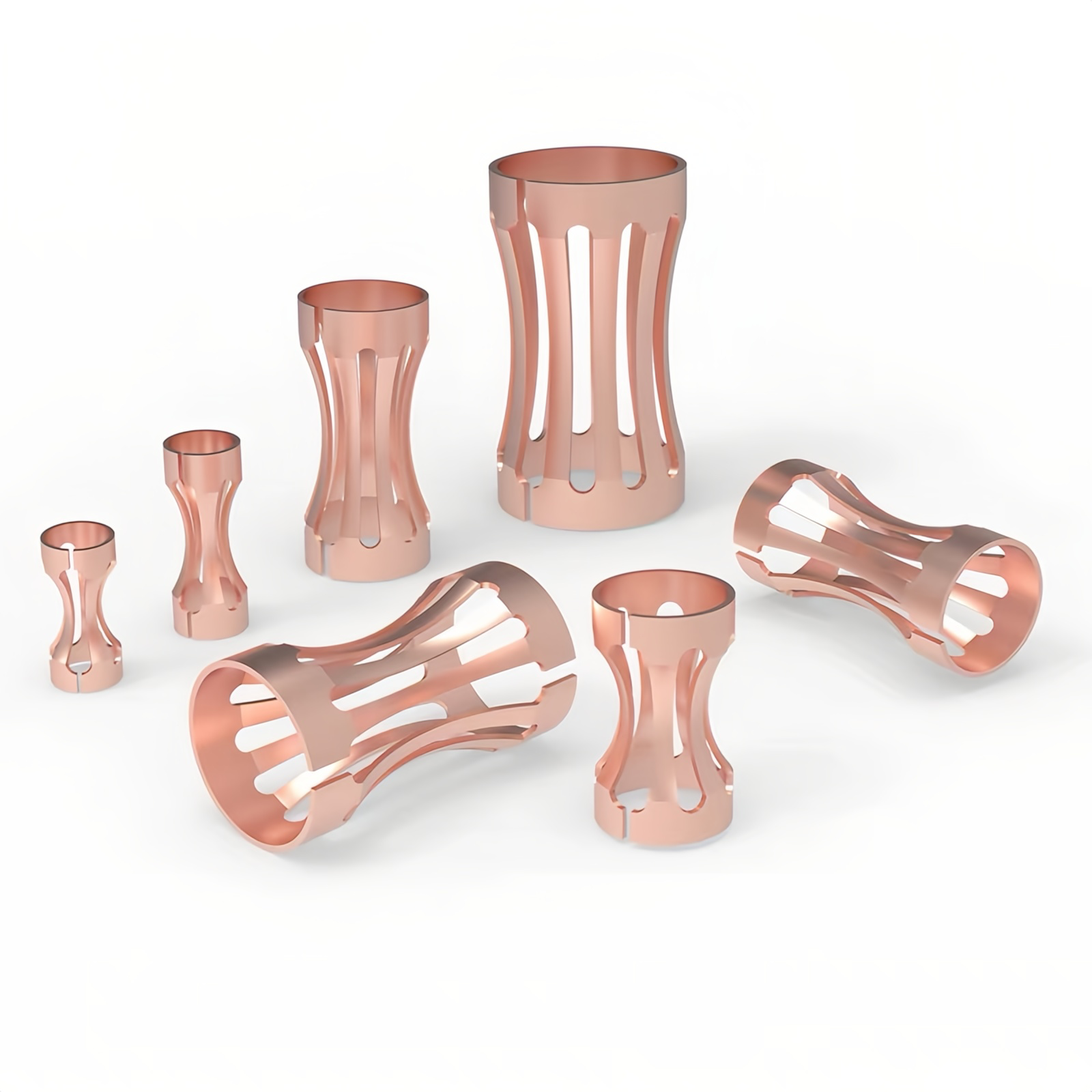
In the field of modern precision electrical connection, crown springs (also known as cage springs) serve as core elastic conductive components. Featuring low contact resistance, vibration resistance, long service life and high current carrying capacity, they have been widely applied in high-demand industries including new energy vehicles, aerospace, industrial electronics and communications. Shaped like a crown or a cage, a crown spring is constructed with multiple elastic reeds whose two ends are fixed to form a ring. Its middle section expands outward and contracts inward, forming a radially flexible hollow elastic body. It acts as the "invisible core" for stable electrical connection of equipment. This article elaborates on the working principle, core structure and performance advantages of crown springs, and analyzes their specific application scenarios across various industries, demonstrating their significant value in the field of precision connection.
I. Core Working Principle of Crown Springs
The working principle of crown springs centers on elastic deformation and multi-point conduction. Essentially, it realizes clamping contact with pins through radial elastic deformation, so as to achieve stable electrical connection. The principle can be analyzed from three dimensions: mechanical performance, electrical performance and vibration resistance, with clear logic and strong practicality.
In terms of mechanical principle, the core mechanism is radial elastic deformation and rebound clamping. When a pin is inserted into the hollow inner cavity of the crown spring, the naturally positioned reeds are radially expanded and elastically deformed. Meanwhile, the elastic restoring force of the reeds evenly acts on the pin surface to generate stable clamping force. This ensures smooth insertion and extraction, provides sufficient retention force, and prevents the pin from loosening and disengagement. This design overcomes the drawbacks of traditional slotted jacks, such as excessive insertion force and pin scratching, while guaranteeing the coaxiality between the crown spring and the pin to enhance connection stability.
In terms of electrical principle, crown springs achieve efficient conduction through annular multi-point line contact and multi-contact parallel current conduction. The tail ends of crown spring reeds are generally bent inward to form crown-shaped claws. After pin insertion, the reeds make annular multi-point line contact with the pin. Standard designs enable 12-point contact, a substantial improvement compared with the 4-point contact of conventional slotted jacks. The contact resistance is steadily controlled within 20 milliohms, which effectively reduces power loss during current transmission, improves current carrying capacity, lowers temperature rise, and prevents connection failures caused by overheating. In addition, the multi-contact parallel design enables shunt current transmission and further stabilizes electrical conduction.
In terms of vibration resistance, crown springs adapt to harsh vibrating environments via redundant multi-point contact. In high-vibration scenarios such as industrial equipment, automobiles and rail transit, even if individual contacts experience momentary disconnection due to vibration, the remaining contacts remain conductive and ensure uninterrupted overall electrical connection. It fundamentally solves the common problems of traditional connecting parts, including loose connection and intermittent circuit failure under vibration, and guarantees reliable equipment operation under severe working conditions.
II. Core Structure and Key Performance Advantages of Crown Springs
2.1 Core Structure Breakdown
Featuring a compact yet sophisticated structure, a crown spring mainly consists of three core components that work synergistically to deliver stable elasticity and electrical conductivity.
-
End Rings (Upper and Lower Rings)
As the fixed structure of the crown spring, end rings connect and fasten elastic reeds, ensuring overall coaxiality and structural strength. Common materials include brass, red copper and beryllium copper, which can be selected flexibly according to mechanical strength and conductivity requirements of application scenarios. For high-end applications, end rings are plated to enhance oxidation resistance.
-
Elastic Reeds
Serving as the core functional unit, elastic reeds are generally composed of 3 to 8 elastic metal strips with inward-bent ends forming crown claws, which are the key contact parts for pin connection and electrical conduction. High-conductivity and high-elasticity copper alloys such as beryllium copper (C17200) and oxygen-free copper (C11000) are preferred; brass (C26000) is adopted for cost-sensitive scenarios. Surface treatments including gold plating, silver plating and nickel plating are commonly applied. Gold plating reduces contact resistance and prevents oxidation; silver plating is suitable for high-current applications; nickel plating focuses on improving wear resistance.
-
Hollow Inner Cavity
The inner cavity provides insertion space for pins, with an inner diameter precisely matched to the pin diameter. This enables reeds to evenly clamp the pin and form stable contact pressure. Dimensional accuracy of the inner cavity directly determines connection stability, with the dimensional tolerance controlled within 0.01 mm in high-precision applications.
2.2 Key Performance Advantages
Compared with traditional slotted sockets and other connecting components, crown springs possess prominent performance advantages, making them widely adopted in high-end industries. The specific advantages are summarized as follows:
First, superior contact stability. The 12-point annular contact design of crown springs delivers a larger contact area and lower, more stable contact resistance, consistently maintaining ≤20 mΩ in long-term operation. In contrast, traditional slotted sockets usually have contact resistance ranging from 50 mΩ to 100 mΩ, which fluctuates easily due to plugging cycles and environmental factors.
Second, extended mechanical service life. The plugging lifespan of crown springs reaches 50,000 to 500,000 cycles. Premium beryllium copper crown springs can exceed 800,000 cycles under high-temperature working conditions, while traditional slotted sockets only last for several thousand cycles. This meets the demands of high-frequency plugging scenarios such as medical devices and testing instruments.
Third, excellent vibration and shock resistance. The redundant multi-point contact design effectively avoids intermittent disconnection caused by severe vibration and impact. It adapts to conventional operating temperatures from -40℃ to +125℃, and extreme temperatures from -55℃ to +150℃ for aerospace applications. Meanwhile, it passes stringent environmental tests including salt spray and radiation resistance.
Fourth, optimized plugging performance. With gentle plugging force (3–15 N), crown springs prevent pin scratching, protecting terminals and improving operational convenience. The stable clamping force also avoids pin detachment and further enhances connection reliability.
Fifth, powerful current-carrying capacity. With the same overall size, crown springs achieve much higher current load than conventional connectors, covering signal-level current (≤5 A) and power-level current (10–300 A and above). They fully satisfy high-current demands of 800 V high-voltage platforms for new energy vehicles and energy storage systems, with lower temperature rise. At 125℃ and 200 A rated current, its temperature rise is 8%–10% lower than the industry average.
III. Detailed Industrial Applications of Crown Springs (Specific to Core Components)
As electronic equipment develops toward miniaturization, high current and high reliability, the application scope of crown springs keeps expanding. They have evolved from traditional consumer electronics to high-value-added fields including new energy vehicles, aerospace and industrial electronics. Different industries select crown springs based on actual working conditions, focusing on stability, current-carrying capacity and vibration resistance. Detailed applications are listed below.
3.1 New Energy Vehicle Industry (Largest Application Scenario)
New energy vehicles impose strict requirements on electrical connection reliability, high-current capacity and vibration resistance. As core contact components, crown springs are widely used in high-voltage and low-voltage connection systems, with a consumption of 28 to 35 pieces per vehicle, acting as critical parts for safe vehicle operation.
-
High-Voltage Connector Components
Mainly applied to internal terminals of battery packs, electric drive systems, on-board chargers (OBC), DC-DC converters and charging guns. They adapt to 300 A+ high current and 800 V high-voltage platforms. Some high-end products adopt welded reed structure combined with copper alloy housing for collaborative heat dissipation, reducing temperature rise by over 30% compared with traditional solutions and ensuring safety and stability during high-power fast charging.
-
Low-Voltage Wiring Harness Components
Used for connector terminals of vehicle body control systems, battery management systems (BMS), and various sensors including temperature, pressure and speed sensors. They transmit control signals and low current, requiring stable contact and vibration resistance to avoid abnormal vehicle operation caused by signal interruption.
-
Charging Interface Components
Serving as conductive contact strips for AC/DC charging guns and vehicle-mounted charging sockets, these crown springs feature plugging resistance, oxidation resistance and high-current bearing capacity. With visual inspection and online dynamic contact resistance testing, the product delivery qualification rate exceeds 99.95%, reducing customers’ incoming inspection costs.
Applicable models cover new energy passenger vehicles, commercial vehicles and energy storage vehicles. Crown springs are indispensable core components for high-voltage and low-voltage connection systems of new energy vehicles.
3.2 Industrial and Power Electronics Industry
Industrial and power electronic equipment usually operates under harsh working conditions with strong vibration, high temperature and high current, requiring highly reliable connecting parts. Relying on vibration resistance, long lifespan and high-current performance, crown springs are widely used in various industrial connection scenarios.
-
Industrial Connector Components
Applied to power and signal terminals of control cabinets, PLCs, servo motors and frequency converters. They solve vibration and high-frequency plugging problems in industrial environments to ensure long-term stable equipment operation. Some products adopt composite plating and optimized elastic coefficient design to balance wear resistance and electrical conductivity.
-
Energy Storage System Components
Adopted in connectors of energy storage cabinets, battery clusters and power conversion systems (PCS). They are designed for high current load, low temperature rise and long service life, matching the long-cycle and low-maintenance characteristics of energy storage equipment. Certain models meet 300 A rated current and 1500 V DC insulation withstand voltage requirements.
-
Rail Transit Components
Used in connectors of EMU traction converters, auxiliary power supplies and axle temperature sensors. They adapt to working temperatures of -40℃ to +125℃ and severe vibration conditions. Each EMU is equipped with more than 2,000 crown springs, which must pass strict vibration and temperature cycle tests to guarantee railway operation safety.
-
Wind Power and Photovoltaic Components
Applied to conductive connections of inverters, junction boxes and wind power slip rings. With outstanding salt spray resistance, wide temperature adaptability and long service life, they are suitable for outdoor harsh environments. Products made of stainless steel with vacuum gold plating can withstand 200 hours of salt spray testing.
3.3 Aerospace and Military Industry
Aerospace and military equipment operate in extreme environments such as vacuum, radiation, extreme temperature and intense vibration, demanding ultimate reliability and stability for connecting components. As high-reliability contact elements, crown springs are the preferred solution for such high-standard equipment.
-
Aviation Plug Components
Equipped in connectors of airborne avionics systems, radar and flight control systems. They meet requirements of high temperature (above 125℃), strong vibration and low impedance, maintaining stable contact resistance without intermittent circuit risks. Some products withstand thermal shock cycles from -65℃ to +200℃.
-
Aerospace Equipment Components
Used for connectors of satellites and rocket structures, adapting to vacuum, radiation and extreme temperature environments to maintain continuous and stable conduction. Miniature crown springs with a nominal diameter of 0.8 mm meet the space-limited installation demands of satellite power boards and drone flight control modules.
-
Military Electronic Components
Installed in waterproof and explosion-proof connectors for military radar, radio stations and military computers. They reach IP67 and above protection grade with excellent shock resistance, vibration resistance and corrosion resistance. Complete production records are provided for each batch to achieve full lifecycle traceability and meet mandatory military industry standards.
3.4 Communication and 5G Industry
Communication and 5G equipment develops toward high density, high frequency and high speed, raising higher standards for connectors in low insertion loss, high stability and miniaturization. Benefiting from low contact resistance and high-frequency stability, crown springs are widely applied in communication facilities.
-
Base Station Equipment Components
Used for power and radio frequency connectors of Massive MIMO radio frequency units, BBU and RRU. They support 28 GHz high-frequency transmission with insertion loss ≤ 0.15 dB to ensure stable signal transmission. Products with patented dual-spiral stress relief structure keep the contact resistance change rate within 3% after 5,000 plugging cycles.
-
Data Center Components
Adopted in power connectors of servers, switches and cabinet systems. Featuring high density, large current load and hot-swap capability, they adapt to high-power and high-maintenance-frequency data center operation and realize miniaturized design to save installation space.
-
Optical Module Components
Serving as gold finger contact strips for high-speed optical modules (400G/800G), they provide low contact resistance and stable high-frequency performance, ensuring efficient conversion of optical and electrical signals to meet high-speed optical communication demands.
3.5 Medical Device Industry
Medical devices require high precision, sterilization compatibility, long service life and low noise for connecting parts. With sophisticated structure and stable performance, crown springs are applied to core connection positions of various medical equipment.
-
Surgical Instrument Components
Used for precision connectors of electrosurgical knives, endoscopes and surgical robots. They feature sterilization adaptability, corrosion resistance and smooth plugging to avoid surgical risks caused by connection failure. Relevant products are certified with RoHS, REACH and halogen-free standards to comply with medical industry regulations.
-
Diagnostic Equipment Components
Equipped in probe connectors of CT, MRI and ultrasonic equipment. Stable signal transmission and low noise performance prevent signal interference and ensure accurate diagnostic results.
-
Monitoring Equipment Components
Applied to sensor interfaces of ECG, blood oxygen and blood pressure monitors. Compact size and high reliability adapt to the miniaturization and portability trend of medical monitoring devices and guarantee stable transmission of physiological signals.
3.6 Consumer Electronics and Home Appliance Industry
Consumer electronics and home appliances focus on miniaturization, cost control and long service life. As precision contact parts, crown springs are widely used in core connection structures of terminal products.
-
Battery Contact Components
Adopted in battery pack contact strips of laptops, power banks and power tools. With plugging resistance and low impedance, they ensure stable power supply and extend product service life. Precision stamping processing burr-free and scratch-free surfaces to improve contact reliability.
-
Charging Interface Components
Used for charging base terminals of high-end earphones, smart watches and drones. Miniature size and long lifespan satisfy miniaturization and high-frequency charging needs of consumer electronics. Custom samples can be delivered within 48 hours to support personalized demands.
-
Home Appliance Control Board Components
Installed in button and connector terminals of air conditioners, refrigerators and washing machines. Balancing low cost and stable performance, they ensure normal transmission of control signals. Hardware and plastic integrated molding reduces assembly errors and vibration noise.
3.7 Precision Instrument and Testing Equipment Industry
Precision instruments and testing equipment have extremely high requirements for connection accuracy and signal fidelity. Crown springs are widely used in testing and measurement fields by virtue of low contact resistance and high dimensional precision.
-
Instrument and Meter Components
Applied to test probe interfaces of multimeters, oscilloscopes and signal generators. Low contact resistance and high signal fidelity eliminate measurement errors and ensure accurate test data.
-
Semiconductor Testing Components
Serving as contact units of chip test sockets and probe stations, they feature fine pitch, high precision and high-frequency resistance to adapt to miniaturized and high-precision semiconductor testing. The dimensional tolerance is controlled within ±0.015 mm to meet precision manufacturing standards.
IV. Conclusion
As a precision elastic conductive component, the core working principle of the
crown spring is to achieve annular multi-point clamping contact with pins through radial elastic deformation. With multi-point parallel current conduction and redundant anti-vibration design, it realizes electrical connection with low contact resistance, high stability, long lifespan and high current capacity. The coordinated operation of end rings, elastic reeds and hollow inner cavities endows crown springs with outstanding mechanical and electrical properties, while optimized material selection and plating processes further expand their application boundaries.
In terms of industrial layout, crown springs have expanded from traditional consumer electronics to high-standard fields including new energy vehicles, aerospace, industrial electronics, communication and medical treatment. They act as core components such as connector terminals and contact strips for various equipment, becoming vital guarantees for stable industrial operation. With the continuous growth of the global crown spring market and rising requirements for connection reliability, crown springs will be further upgraded in precision manufacturing, material optimization and structural innovation, providing more reliable solutions for modern high-precision electrical connection systems.

 Tiktok

 Kwai

 REDnote


