I. Green Power (Wind + PV): "Elastic Framework" for Severe Outdoor Service Conditions
Green power facilities operate long-term under ambient conditions ranging from -40℃ to +85℃ with strong wind, sand dust and intensive ultraviolet radiation. Specified springs must deliver four key properties: fatigue resistance, low stress relaxation, corrosion resistance and high dimensional precision. The standard fatigue lifespan is no less than 1.5 million cycles with maximum allowable stress relaxation ≤5%.
(1) Wind Power Sector
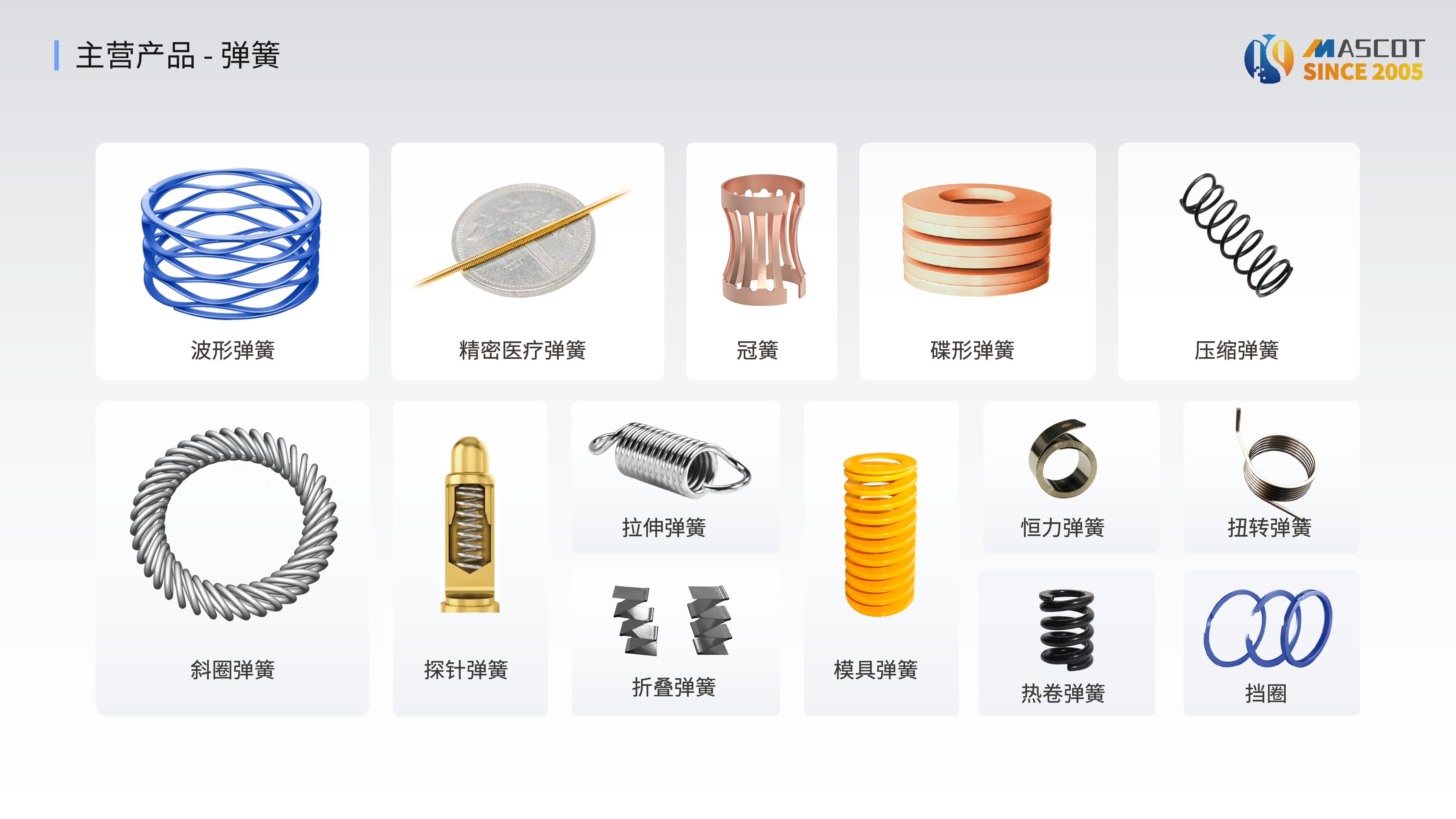
1. Pitch & Yaw System: Disc Springs + Compression Springs
- Application: Pitch drive units inside wind turbine hubs, yaw brakes in nacelles
- Function: Torque compensation, backlash elimination, brake pressure retention; resistance against violent wind impact and mechanical vibration
- Key specs: Load 5~20kN, working stroke 10~50mm, fatigue life ≥2 million cycles, operating temperature -40℃~+120℃
- Materials: 50CrVA (quenched & tempered, HRC45~52), 17-7PH stainless steel (corrosion-resistant)
2. Circuit Breaker & Disconnector: Finger Contact Springs + Return Springs
- Application: GIS switches and vacuum circuit breakers at booster substations of wind farms
- Function: High-current conduction (contact resistance ≤10μΩ), rapid switch-on/off, electric arc buffering
- Key specs: Contact force 50~200N, rated conductive current 1~5kA, arc erosion resistance, plug-in service life ≥100,000 cycles
- Materials: Silver-plated copper alloy (conductive grade), 60Si2MnA (for reset function)
3. Tower & Blade Vibration Damping: Spring Supports + Damping Springs
- Application: Internal cable fixing inside wind towers, dampers at blade root sections
- Function: Vibration isolation, thermal displacement compensation, resonance suppression to mitigate fatigue damage of wind turbines
- Key specs: Spring stiffness 50~500N/mm, natural frequency 1~5Hz, withstand vibration acceleration ≥5g
- Materials: 65Mn spring steel, anti-corrosion stainless steel
(2) PV Power Sector
1. Inverter & Combiner Box: Canted Coil Contact Springs + Relay Springs
- Application: Power modules of PV inverters, busbar joints of combiner boxes, DC contactors
- Function: High-current elastic connection (≤5kA), low contact resistance, anti-vibration, temperature compensation
- Key specs: Contact force 30~150N, contact resistance ≤5μΩ, operating temperature -40℃~+125℃, anti-ageing performance
- Materials: Beryllium copper / Cu-Cr-Zr alloy (conductive; 40% lower relaxation vs phosphor bronze), stainless steel
2. PV Solar Trackers: Torsion Springs + Gas Springs
- Application: Rotary joints of single/dual-axis solar trackers, panel flip-over mechanisms
- Function: Angular reset, gravity balance, auxiliary driving to improve tracking accuracy ≤0.5°
- Key specs: Torque 50~500N·m, working rotating angle 0~180°, withstand wind load ≥20m/s
- Materials: 60Si2MnA (torsion grade), high-strength carbon steel (gas spring base)
3. Mounting Bracket Fastening: Compression Springs + Wave Springs
- Application: Anti-loose bolt assemblies for PV supports, elastic cushion for module clamping blocks
- Function: Thermal expansion & contraction compensation, anti-loosening & damping, uniform pressure distribution for outdoor temperature fluctuation from -40℃ to +85℃
- Key specs: Spring force 20~100N, compression deflection 5~20mm, anti-ageing & anti-corrosion
- Materials: 304/316 stainless steel, weather-resistant spring steel
II. Energy Storage Industry (Electrochemical / CAES / Pumped Hydro Storage): "Core Elastic Components" for High Safety & Long Cycle Life
By the end of 2024, China’s installed capacity of new-type energy storage reached 48.7GW, representing a year-on-year growth of 112%. Over 90% of power conversion systems (PCS) adopt custom-designed springs, which are required for high insulation, high-current bearing, long cyclic endurance and thermal shock resistance.
(1) Electrochemical Energy Storage (Lithium-ion / Flow Batteries)
1. Battery Module Interconnection: Canted Coil Contact Springs + Conductive Springs
- Application: Cluster connection inside energy storage cabinets, BMS sampling terminals, busbars of high-voltage boxes
- Function: Elastic power conduction (≤3kA), assembly tolerance elimination, anti-vibration & thermal compensation; reduce contact resistance ≤5μΩ to prevent thermal runaway
- Key specs: Contact force 50~200N, cycle life ≥5,000 cycles, operating temperature -20℃~+85℃, dielectric withstand voltage ≥2kV
- Materials: Silver-plated beryllium copper (conductive), stainless steel (elastic support), copper alloy
2. PCS Power Conversion System: Switch Springs + Buffer Springs
- Application: PCS circuit breakers, IGBT module preloading, DC-side contactors
- Function: Fast make-and-break (≤10ms), arc buffering, module compaction, noise reduction
- Key specs: Actuating force 100~500N, switching speed ≥1m/s, arc resistance, fatigue life ≥1.5 million cycles
- Materials: 50CrVA, high-strength 60Si2MnA, copper-tungsten alloy (arc contact material)
3. Fire Protection & Pressure Relief: Pressure Springs + Sealing Springs
- Application: Pressure relief valves, explosion-proof doors and fire sprinkler trigger devices of energy storage cabinets
- Function: Overpressure opening (0.5~1.5MPa), sealing & pressure holding, emergency reset for safe pressure venting during thermal runaway
- Key specs: Cracking pressure 0.8±0.1MPa, sealing working pressure ≥2MPa, service temperature -40℃~+120℃
- Materials: 316 stainless steel, high-temperature resistant Inconel 718, FKM-coated sealing grade
(2) Compressed Air Energy Storage (CAES)
1. High-pressure Valves: Disc Springs + Sealing Springs
- Application: Inlet/outlet valves of gas storage caverns, high-pressure regulating valves (10~30MPa working pressure)
- Function: High-pressure sealing, pressure compensation, spool reset to offset ±5% pressure fluctuation and alternating temperature shift
- Key specs: Rated sealing pressure ≥30MPa, compensation stroke 5~15mm, fatigue life ≥100,000 cycles, operating temperature -40℃~+150℃
- Materials: Inconel 750, Hastelloy C (hydrogen embrittlement & corrosion resistant), modified PTFE cladding
2. Expander & Compressor Units: Damping Springs + Gas Springs
- Application: Base vibration damping of compressor sets, flexible support for inlet & outlet pipelines
- Function: Vibration isolation (max amplitude ≤0.1mm), thermal displacement compensation, noise control ≤75dB
- Key specs: Stiffness 100~1000N/mm, natural frequency 2~8Hz, withstand vibration acceleration ≥10g
- Materials: 65Mn spring steel, stainless steel, high-damping rubber composite
(3) Pumped Hydro Storage
1. Hydro Turbine & Generator: Bearing Preload Springs + Governor Springs
- Application: Elastic support for water guide bearings, pressure regulating assemblies of governors
- Function: Bearing preloading, clearance compensation, rotational speed stabilization and vibration suppression
- Key specs: Preload force 5~20kN, regulating stroke 10~30mm, fatigue life ≥2 million cycles, water corrosion resistance
- Materials: 50CrVA, corrosion-proof 17-4PH stainless steel, wear-resistant bronze alloy
III. Hydrogen Energy Industry (Hydrogen Production / Storage & Transportation / Refueling / Fuel Cell): "Safety Barrier" against Hydrogen Embrittlement & Extreme Service
Core challenges for hydrogen facilities include ultra-high pressure (70MPa), cryogenic environment (-253℃ for liquid hydrogen), hydrogen embrittlement risk and rigorous sealing requirements. All relevant springs must pass SSRT hydrogen embrittlement test with elongation drop ≤2% and fatigue limit reduction ≤3% under hydrogen atmosphere.
(1) Water Electrolysis for Hydrogen Production (Alkaline / PEM)
1. Electrolyzer Sealing: Disc Springs + Spring Energized Seals
- Application: End-plate clamping of alkaline electrolyzers, MEA compaction of PEM stacks, elastic backing for sealing gaskets
- Function: Uniform clamping pressure (5~15MPa), pressure retention sealing, thermal expansion compensation to curb H₂/O₂ leakage; overall leakage rate ≤5ppm/h
- Key specs: Clamping load 10~50kN, compensation stroke 3~10mm, working temperature 80~120℃, hydrogen embrittlement resistance
- Materials: Inconel 718/750, Hastelloy C (anti-hydrogen embrittlement), modified PTFE + metal spring composite for seals
2. H₂/O₂ Separators: Pressure Springs + Regulating Springs
- Application: Pressure control valves and liquid-level trigger structures of gas separators
- Function: Stable operating pressure (1.5~3MPa), liquid-level interlock control and overpressure protection to guarantee gas-liquid separation efficiency
- Key specs: Cracking pressure 2.0±0.2MPa, regulating accuracy ≤±1%, fatigue life ≥500,000 cycles
- Materials: 316L stainless steel, special hydrogen-resistant steel (e.g. Nippon Seisen HYBREM grade)
(2) Hydrogen Storage & Transportation (High-pressure / Liquid H₂)
1. 70MPa High-pressure Hydrogen Cylinders: Sealing Springs + Thermal Compensation Springs
- Application: Cylinder neck valves, head sealing structures, tank thermal expansion compensation assemblies
- Function: 70MPa high-pressure sealing, ±5% volume compensation during gas filling/discharging, hydrogen permeation & embrittlement prevention
- Key specs: Sealing rating ≥80MPa, compensation travel ≥30% of total length, operating temperature -40℃~+85℃, leakage ≤5ppm/h
- Materials: Inconel 750, titanium alloy, HYBREM hydrogen-resistant stainless steel, metal bellows (for displacement compensation)
2. Liquid Hydrogen Transportation (-253℃): Cryogenic Springs + Thermal Insulation Support Springs
- Application: Support frames of LH₂ tanks, cold compensation for transfer pipelines, cryogenic valve sealing
- Function: Preserve elastic property under ultra-low temperature, thermal shrinkage compensation, adiabatic damping and cold-shock cracking prevention
- Key specs: Working range -253℃~+85℃, ≥90% elastic retention at cryogenic condition, compensation stroke 10~50mm
- Materials: Inconel 718, high-toughness 316LN stainless steel, lightweight titanium alloy
(3) Hydrogen Refueling Station (35/70MPa)
1. Dispenser Valves: High-pressure Springs + Poppet Return Springs
- Application: Check valves inside refueling nozzles, emergency shut-off valves, 70MPa pressure regulators
- Function: High-pressure on-off control, rapid reset ≤50ms, backflow prevention and pressure stabilization to ensure safe refueling
- Key specs: Nominal working pressure 70MPa, cracking pressure 0.5~1MPa, reset force 50~200N, hydrogen embrittlement resistant
- Materials: HYBREM hydrogen-proof stainless steel, Inconel 750, titanium alloy
2. Nozzle Coupling Assembly: Contact Finger Springs + Sealing Springs
- Application: Interface between dispenser nozzle and onboard tank receptacle, conductive/earthing contact terminals
- Function: Elastic coupling, low contact resistance, pressure retaining sealing and anti-dropout against vibration for high-pressure plugging operation
- Key specs: Contact force 100~300N, sealing pressure ≥70MPa, plug-in lifespan ≥10,000 cycles, corrosion resistance
- Materials: Silver-plated beryllium copper (conductive), Inconel 718 (sealing), hydrogen-resistant specialty alloy
(4) PEM Fuel Cell (PEMFC)
1. Stack Compression: Disc Springs + Wave Springs
- Application: End-plate preloading of fuel cell stacks, single-cell clearance compensation
- Function: Uniform stack compression (1~3MPa), 0.1~0.3mm thermal expansion compensation, MEA protection and hydrogen leakage prevention
- Key specs: Clamping load 5~20kN, compensation stroke 2~8mm, operating temperature 60~80℃, insulation withstand ≥1kV
- Materials: Inconel 718, 316 stainless steel, insulation-coated spring steel
2. Hydrogen Supply System: Regulator Springs + Check Valve Springs
- Application: Tank pressure reducing valves, pipeline check valves, circulation pump pressure regulators
- Function: Precise pressure adjustment (0.2~0.5MPa), unidirectional flow control, pressure stabilization and hydrogen embrittlement resistance
- Key specs: Regulation tolerance ≤±0.05MPa, cracking pressure 0.1~0.3MPa, fatigue life ≥100,000 cycles
- Materials: HYBREM hydrogen-proof stainless steel, Inconel 750, titanium alloy
IV. Common Performance Rules & Material Selection Guidelines by Industry
(1) Shared Core Performance Requirements
- Green Power: Anti-fatigue, low relaxation, outdoor corrosion resistant; service life ≥1.5 million cycles
- Energy Storage: High-current capacity, superior insulation, long cycling, thermal shock resistant; ≥5,000 operating cycles
- Hydrogen Energy: Hydrogen embrittlement resistance, ultra-high pressure/cryogenic tolerance, premium tightness, low leakage ≤5ppm/h
(2) Material Priority Ranking
- Hydrogen (HP/Cryo): Inconel718/750 → Hastelloy C → Titanium Alloy → HYBREM Hydrogen-resistant Stainless Steel
- Green Power & Storage (Conductive Parts): Silver-plated BeCu → Cu-Cr-Zr → Phosphor Bronze
- General Structural (Damping/Reset): 50CrVA / 60Si2MnA → 304/316 Stainless Steel
(3) Key Industry Standards
- GB/T 1239.6-2009: Spring Load Test & Fatigue Life Verification
- DL/T 686-2019: Specification for Spring Selection & Installation of Electric Power Equipment
- IEC 60255: EMC & Environmental Adaptation Standard for New Energy Electrical Springs
- T/CES 382-2025: Working Condition Specification for Water Electrolysis under High-penetration Renewable Power Grid
V. Conclusion
Springs have evolved from trivial small parts into mission-critical functional components across green power, energy storage and hydrogen sectors, directly determining equipment safety, operational stability and service lifespan. Green power springs prioritize outdoor durability; energy storage products focus on high-current endurance and long cycle performance; hydrogen-grade springs center on hydrogen embrittlement resistance and extreme condition adaptability. As these industries evolve toward higher voltage, larger capacity, elevated working pressure and lower operating temperature, market demand for custom-engineered, high-reliability extreme-duty specialty springs will keep growing rapidly, forming an indispensable link within the new energy supply chain.
Mascot Technology | 20+ Years Professional Spring Manufacturer | www.hespring.com

 Tiktok

 Kwai

 REDnote


