Mascot Precision Springs: The "Mechanical Ligaments" of Humanoid Robots and Embodied Intelligence
Source: Website
Amid the accelerated commercialization of humanoid robots and embodied intelligence technologies, precision springs act as core elastic components for joint actuation, energy storage & shock absorption, flexible interaction and dynamic balancing, earning them the name of the robot’s "mechanical ligaments". With over 20 years of expertise in the R&D and manufacturing of precision springs, Mascot Technology leverages its global smart manufacturing layout, advanced material technologies and micron-level processing capabilities to develop a full range of spring products tailored for humanoid robot applications. We deliver highly reliable, long-service-life and customized elastic solutions for the industry.
I. Industry Trend: Springs Become an Indispensable Core Component for Humanoid Robots
The year 2026 ushers in a crucial phase for the large-scale deployment of humanoid robots worldwide. Series Elastic Actuators (SEA) and Parallel Elastic Actuators (PEA) have become mainstream architectures, and precision springs are installed on more than 80% of humanoid robot joints. According to industry statistics, the global market size of elastic components for humanoid robots reached approximately 774 million RMB in 2025. It is projected to hit 7.448 billion RMB by 2032, with a compound annual growth rate of 37.8%.
Springs perform four core functions in humanoid robots: ◦Compliant joint control: Simulate the elasticity of biological tendons, mitigate rigid impact and improve the safety of human-robot interaction. ◦Energy storage and efficiency enhancement: Store kinetic energy during walking and jumping, and assist actuation when releasing energy, cutting energy consumption by over 25%. ◦Shock and vibration resistance: Absorb impact generated from landing and collision, and protect sophisticated components such as reducers and sensors. ◦Reset and positioning: Enable accurate reset of lightweight joints including fingers and wrists to ensure motion precision.
A single humanoid robot is equipped with 30 to 40 springs in total, among which 20 to 30 are fitted on dexterous hands and 8 to 10 on the torso and lower limbs. High-end customized springs are valued at over 3,000 RMB per robot, representing huge market potential.
II. Mascot’s Core Spring Products: Full-scenario Solutions for Humanoid Robots
Mascot Technology is equipped with more than 1,000 sets of precision production equipment, including 160 compression, tension and torsion spring machines and 60 CNC spring machines, as well as over 20 sets of professional testing devices. We have obtained IATF16949 quality management system certification. Our springs feature a maximum fatigue life of over 100 million cycles and a machining precision of ±0.005 mm, fully compatible with all joint applications of humanoid robots.
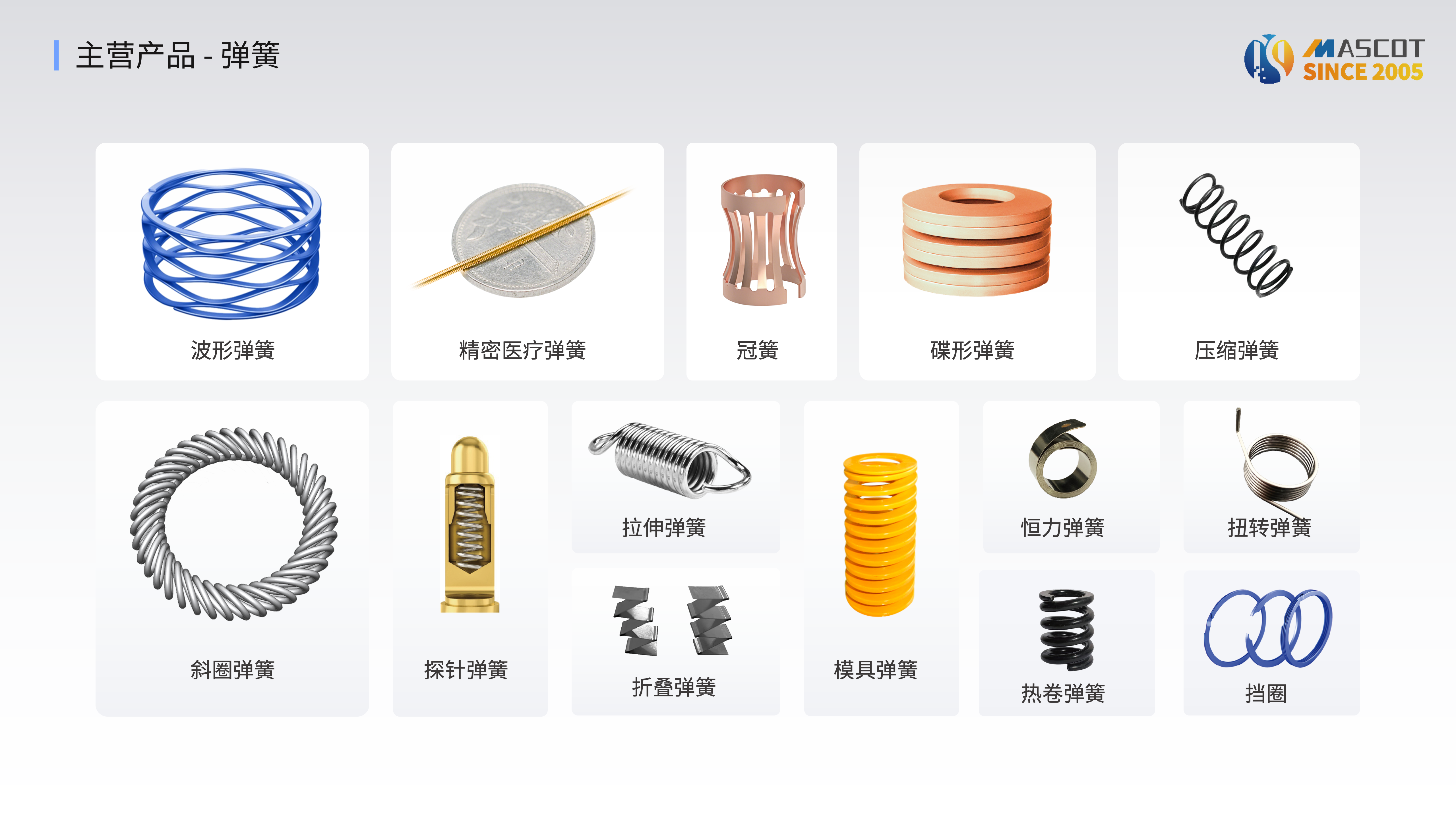
1. Precision Coil Springs (Cylindrical / Tapered) ◦Application: Shoulder, hip and knee joints for SEA actuators, torso balancing units and leg energy storage units ◦Core Functions: Simulate tendon tension, absorb impact, store and release energy, and reduce joint inertia ◦Mascot Advantages: Manufactured from premium materials including chrome-silicon alloy and Inconel 718, these springs withstand temperatures above 150°C and deliver excellent fatigue resistance. Compared with conventional carbon steel springs, they achieve 30% weight reduction and a 5-fold longer service life. Custom designs with variable diameter and stiffness are available.
2. Belleville Disc Springs (Stacked Type) ◦Application: Load-bearing hip and knee joints, reducer overload protection and ankle shock absorption modules ◦Core Functions: High rigidity, large load capacity in limited space, non-linear force-displacement performance and superior impact resistance ◦Mascot Advantages: Outer diameter ranges from 3 mm to 900 mm, and thickness from 0.08 mm to 60 mm. Available as single pieces or stacked assemblies.
3. Torsion Springs ◦Application: Finger joints, wrist joints, ankle joint angle reset and lightweight joint actuation ◦Core Functions: Angular displacement control, reset torque output, torque generation in compact spaces and bionic ligament rebound ◦Mascot Advantages: The minimum wire diameter of micro torsion springs is Φ0.05 mm, with a repeat positioning accuracy of ±0.02°.
4. Micro Extension Springs ◦Application: Cable-driven dexterous hands, micro-motion control for eyelids and necks, and sensor reset ◦Core Functions: High elasticity, lightweight structure, precise tension control and adaptability to miniature spaces ◦Mascot Advantages: Wire diameter ranges from Φ0.03 mm to 0.1 mm. Made of high-carbon steel or stainless steel, the tension tolerance is controlled within ±5%.
5. Wave Springs ◦Application: Joint gap compensation, lightweight rotary joints, integrated sealing and buffering units ◦Core Functions: Reduce axial space occupancy by 50%, low rigidity with high elasticity, uniform load distribution and outstanding fatigue resistance ◦Mascot Advantages: Outer diameter: 1 mm – 500 mm, thickness: 0.1 mm – 10 mm, precision: ±0.01 mm, operating temperature: -260°C to 600°C. Ideal for compact joints of humanoid robots, wave springs replace traditional coil springs to cut joint volume by 30% and improve transmission stability. They are widely adopted in precision joints of surgical robots and collaborative robots.
6. Non-linear Springs (Variable Stiffness / Combined Type) ◦Application: Knee joints, ankle joints, dynamic balancing joints and jumping robots ◦Core Functions: Stiffness adaptive to deformation, simulation of muscle load characteristics, improved gait stability and high energy efficiency ◦Mascot Advantages: Adopting combined structures (coil spring + disc spring, wave spring + torsion spring) or special alloy variable cross-section technology to realize dynamic stiffness adjustment along with joint angle changes.
III. Mascot Technology: 20 Years of Precision Manufacturing Empowering the Robotics Industry
Founded in 2005, Mascot Technology is a Sino-foreign joint venture specialized in the R&D and production of precision springs and sealing components. Headquartered in Taicang, Jiangsu Province, we operate four smart manufacturing bases in Taicang, Shaoxing, Dallas (USA) and Chon Buri (Thailand), together with a liaison office in Tianjin. Our facility covers 20,000 square meters of standard factory space. The company has 398 employees, including 168 professional technicians, with an annual production capacity of over 10 million precision springs.
Core Competitiveness 1.Advanced Material Technology: We master the forming technologies of high-end materials such as chrome-silicon alloy, Inconel 718, titanium alloy and high-temperature stainless steel, enabling products to adapt to extreme working conditions. 2.Micron-level Machining Capability: The minimum wire diameter of micro springs reaches Φ0.01 mm (medical grade), and the yield rate of mass production stays above 98%. 3.Rapid Customization Service: Our R&D team boasts rich industry experience from Europe and America. The whole process from design to mass production can be completed in as fast as 15 days. We provide custom solutions for non-standard structures, special stiffness and extreme temperature requirements to fit various humanoid robot models. 4.Global Delivery & After-sales Service: Overseas production bases ensure local supply. We offer 24-hour technical support nationwide, free on-site inspection for bulk customers, and free replacement for non-artificial damage within the warranty period.
IV. Selection Guide: Mascot Springs for Key Scenarios of Humanoid Robots
Application Position
Recommended Spring Type
Core Requirements
Advantages of Mascot Solutions
Load-bearing Joints (Knee / Hip)
Belleville Disc Spring + Coil Spring
Heavy load resistance, impact resistance, long service life
Stacked disc springs for high rigidity + alloy coil springs for energy storage; service life over 100 million cycles
Dexterous Hands & Wrists
Micro Extension Spring + Torsion Spring
Lightweight, high precision, compliant interaction
Multi-directional buffering, stable landing, energy saving
Save 50% installation space, adaptive stiffness, 40% impact reduction
Torso & Waist (Dynamic Balancing)
Tapered Coil Spring
Low inertia, fast response, posture recovery
Variable diameter design for lightweight; 30% shorter response time
V. Conclusion
The booming development of the humanoid robot industry relies heavily on technological support from precision elastic components. Drawing on 20 years of experience in precision manufacturing, advanced material technologies and professional customization capabilities, Minshuo Technology has built a full-range spring product portfolio tailored for all application scenarios of humanoid robots.
Going forward, Minshuo will continue to increase investment in R&D, focus on technological breakthroughs for springs featuring high rigidity, low energy consumption and long service life for humanoid robots, and expand production capacity. We will work together with global partners to accelerate the large-scale commercialization of humanoid robots and jointly foster a new ecosystem for embodied intelligence.

 Tiktok

 Kwai

 REDnote


