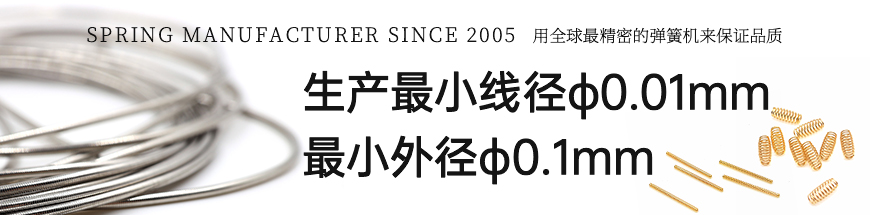
Capillary minimally invasive guide wire spring is a functional component designed specifically for extremely thin pipelines (such as blood vessels or cavities with a diameter of ≤ 0.5mm). It is usually integrated at the front end of the minimally invasive guide wire and forms a spiral structure through precision winding technology. Its core function is to achieve precise guidance and safety protection in ultra small spaces. It is a key component of high-end minimally invasive technologies such as cardiovascular and neurological interventions.
Core function: Breaking through the "micrometer level" operational limit
Ultra fine pathway navigation
The spiral structure of the spring can adapt to the tortuous direction of capillaries through active shaping (such as J-shaped, spiral shaped), for example, in intracranial aneurysm embolization, the tip of the spring can branch through 0.3mm blood vessels. Its flexible design can avoid direct damage to the vascular wall by rigid guide wires, especially suitable for fragile microvessels such as retinal vessels.
Mechanical performance optimization
Balance between support and flexibility: The spring is wrapped with multiple strands of alloy wire (such as platinum iridium alloy+nickel titanium alloy), with tight wrapping at the proximal end to enhance push support and loose wrapping at the distal end to enhance compliance, and can pass through lesion channels with a stenosis rate greater than 90%.
Improved bending resistance: Ultra fine springs with wire diameters of 0.025-0.1mm achieve uniform stress distribution through laser cutting technology, and maintain performance even after repeated bending 100000 times.
Development and positioning assistance
The mainstream springs use platinum iridium alloy or gold plating technology, which can be clearly developed under X-ray fluoroscopy. Doctors can adjust the direction in real time through the development mark on the tip of the spring, with an error of less than 0.1mm. Some high-end products integrate magnetic positioning components and achieve three-dimensional spatial positioning through external magnetic field tracking.
Key technical feature: engineering breakthrough in millimeter level precision
material innovation
Platinum iridium alloy: high development performance (X-ray attenuation coefficient is three times that of stainless steel), excellent biocompatibility, suitable for long-term implantation scenarios.
Nickel titanium alloy: super elastic (strain up to 8%), can automatically restore shape when passing through severe calcified lesions, avoiding rebound after shaping.
manufacturing process
Laser precision winding: Using alloy wire with a diameter of 0.015mm, the winding accuracy of 0.001mm level is achieved through five axis linkage laser equipment, and the spring pitch error is less than ± 5 μ m.
Electrolytic polishing technology: removes burrs on the surface of the spring, reduces the friction coefficient to below 0.02, and can significantly improve passability when combined with PTFE coating.
structural design
Variable diameter spring: with a proximal wire diameter of 0.1mm and a distal wire diameter of 0.05mm, it balances the transmission of pushing force and tip flexibility, making it suitable for narrow "bottleneck" situations.
Double layered composite structure: The inner layer is reinforced with stainless steel support, and the outer layer is made of nickel titanium alloy to enhance fatigue resistance. It has not fractured in 100000 bending tests.
Technical Challenges and Development Trends
Current bottleneck
Mechanical equilibrium at ultrafine sizes: When the spring diameter is less than 0.05mm, the contradiction between support force and flexibility intensifies, and it is necessary to break through the limit through molecular level material design (such as carbon nanotube reinforced alloys).
Biocompatibility optimization: Long term implantation of platinum iridium alloy may cause mild inflammatory reactions, requiring the development of nano coating technology (such as hydroxyapatite coating).
Future Direction
Intelligent guide wire: Integrated pressure sensor or optical imaging module, real-time feedback of vascular wall tension to avoid excessive pushing leading to perforation.
3D printing customization: Based on patient vascular CTA data, personalized design of spring shape to achieve precise treatment with "one person, one guide wire".
The capillary minimally invasive guide wire spring is the "dancer on the needle tip" in the field of minimally invasive intervention. Through ultra-fine design, precision manufacturing processes, and intelligent functional integration, it achieves a perfect balance between "precise control" and "safety protection" in micrometer level space. With the advancement of materials science and intelligent manufacturing technology, these "invisible" medical devices will continue to drive the development of interventional surgery towards finer and more minimally invasive directions.


 Tiktok

 Kwai

 REDnote


